Posts Tagged With: #writing

Criticism and Rejection

Rejection is part of the writing business. I found I need to have a thick skin, or I won’t last long. It is a given there will be things said about my writing that will cut deeply.

Critique groups are one of the places you may feel the sharp knife of criticism and rejection. I hand over my precious manuscript to be read by members of the group, and I have copies of theirs. I spent hours carefully reading and noting, what I believe will be helpful, constructive criticism.  I hope they will do the same for me. Then we meet on the appointed day, sit and wait for them to tell me how wonderful I am.

startup-594090_1920

There are two types of groups – the first is the ones I sat through in college, there are forty or so students and somewhere is that one person who just wants to see if they can make someone cry. They often don’t comment on the writing but attack the writer. Saying things like – you’re the worst writer I’ve ever seen, this was a waste of paper and/or my time, or seriously, you call yourself a writer? The whole time I sit holding back the tears wondering why the professor or grad student who’s the moderator is allowing this verbal abuse. It was because of this type of group I stopped writing for nearly twenty years.

The second critique group is preferable. This is a smaller group, generally no more than five (but there are exceptions.) These are real writers, who want to be their best and want me to also be a better writer. They can be tough. If something in the story isn’t working they tell me with bare-naked honesty. Yes, it still hurts, but it’s the writing, not me as a person. I have gone home several times, mad as a cat forced to take a bath. I lick my wounds for a few days, telling myself they are wrong, wrong, WRONG! Then I look at the chapter and, damn it, they were right, and I make the changes. Real critique groups are a blessing.

Then, of course, there are those dreaded Rejection Letters. I’m sitting here right now with my first rejection in front of me. I’ve re-read it a dozen times, sipping my English Breakfast Tea, and wondering what was wrong with my story? The letter doesn’t give me much of a clue.

March 1, 2017

Tess DeGroot,

Thank you for submitting your short story, Ghost of Tanager Lodge, to XXX’s 2017 annual anthology edition of the ‘XXX’ series, “XXX.” After reviewing your submission, we have decided not to include your story in this installment; however, we look forward to any other stories you submit to future ‘XXX’ compilations. The 2018 volume’s theme, title, submission guidelines, and deadline will be announced April 1, 2017.

Some of the possible reasons for receiving a “1” may have been: more telling than showing, high rate of predictability in the plotline, lack of or ineffective storyline/plot/characters, or poor editing (or not edited at all by a second-party editor), and some failed to meet the minimum requirement of containing a ghost or haunting. You are encouraged to continue to hone your skills and submit again to future ‘XXX’ editions.

Thanks again for submitting.

I’m sure it will be the first of many.

My friend and fellow writer, Brent A. Harris, has been commiserating with me as he got the same later for the story he submitted. He’s been writing longer than I have and has received his share of rejection letters. He said it “took a year and 30ish rejections” before one of his stories was accepted.  He now has two stories published in anthologies, Tales of Wonder  and Tales from Alternate Earths

But we’re not alone in facing rejection. Isaac Asimov displayed his rejection letters on the wall of his office. Stephen King hung his on a nail next to his desk until the nail fell out of the wall. J.K. Rowling recently tweeted some of her rejection letters to encourage new writers.

Nobody said being a writer was easy. When I write, I risk being cut to my very soul every time I share my words. Yes, there will be criticism, rejection, and even have a few bad reviews along the way. But as Brent said, he “will dust it off and revise it to submit elsewhere,” and I will do the same.
computer

Brent recently shared a writer’s prayer with a group we belong to on Facebook:

The Writer’s Prayer:
Grant me the words to write the story
The wisdom to revise and edit
The success to keep me going
And the rejections to keep me humble

These words are now on a card on my desk, a reminder to keep telling stories, to keep taking risks, and to take the writing seriously but not myself.

Until next time . . .

The door is always open and the kettle is always on.
Categories: Uncategorized | Tags: , , , , , , | 7 Comments

Train Tracks and Tea Cups

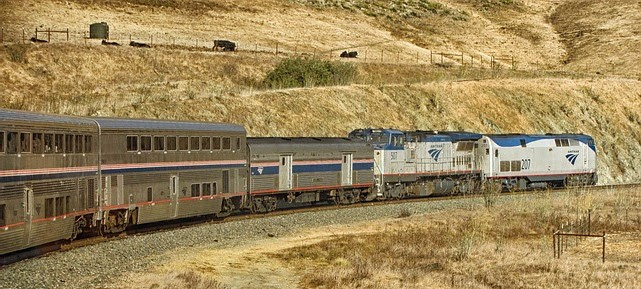
Amtrak Southwest Chief

Sitting in my room with my cup of jasmine green tea with peppermint, I can hear the train whistle as it passes through Victorville. If it weren’t for the trains, Victorville and Barstow wouldn’t exist. They were “train towns.” And the sound of them passing through makes me nostalgic.

I love trains. I think it’s in my DNA. One great-grandfather was a chaplain serving workers building and repairing the lines in the Ohio Valley. Another was a coalman for a freight line.

Men working on the rail work circa 1895 (the second man from the left is my great-great-uncle.)

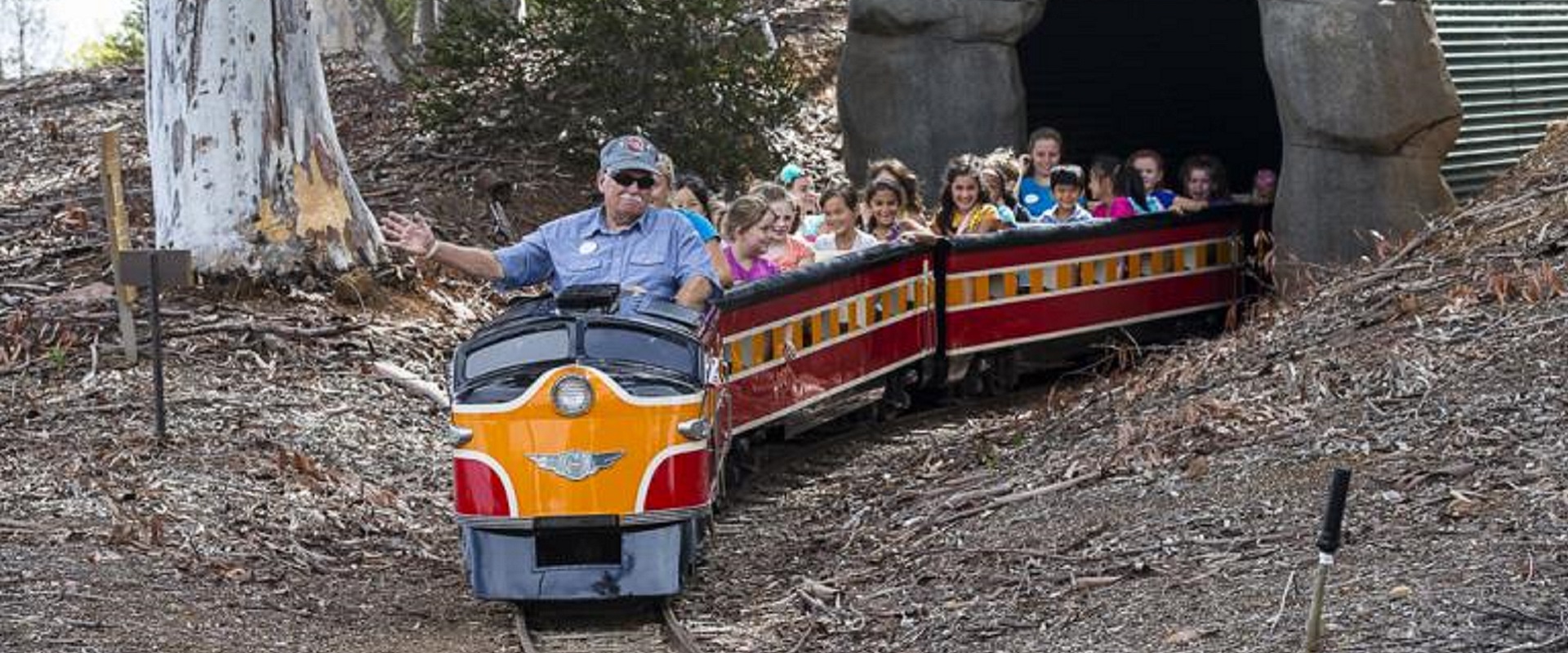
I will ride a train – any train – when I get the chance. Yes, even the replica trains of Disneyland and Knott’s Berry Farm or the little kiddie trains at the park.

Kiddie train Balboa Park, San Diego

One well-remembered train ride from childhood was on a Santa Fe Railroad passenger train. We boarded the train at the old Santa Fe Depot (now Amtrak) with a group of friends. The wooden benches faced the windows and were painted yellow and red. The air smelled of diesel fuel and saltwater. We disembarked at the small station at Del Mar and hiked down to the beach. Just before sunset, we boarded the train back to San Diego. The next day, there were no more Santa Fe passenger trains.

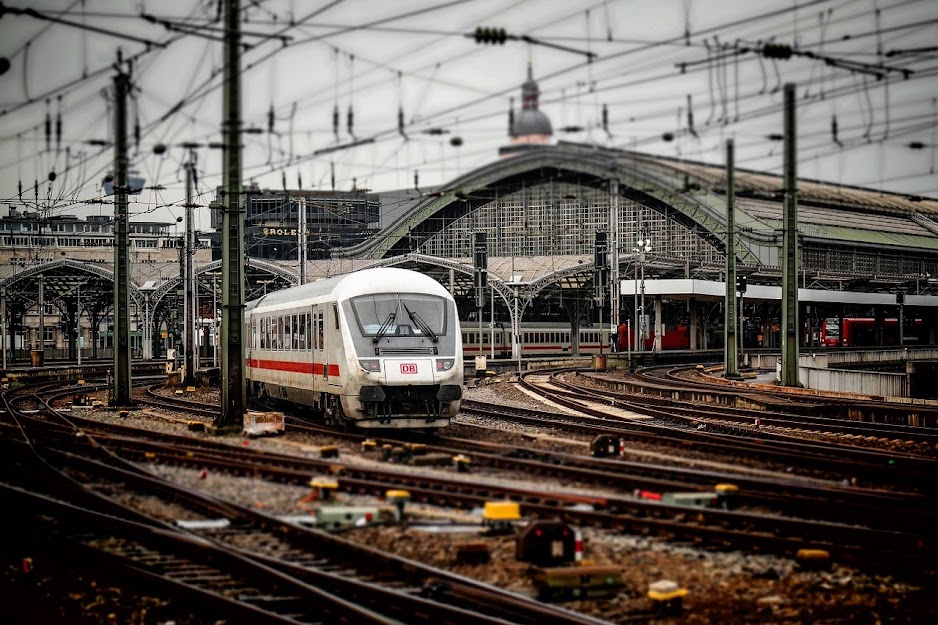
The summer before I was married, I went to Europe and rode the rails. From Amsterdam to Vienna, to Istanbul, and Paris. I shared meals and stories with fellow passengers. On the ride to Istanbul, aboard the “Orient Express,” to meet my former exchange student “sister,” as we passed into Hungary. The border official walked off the train with my passport. To say I was panicking would be an understatement.   The father of the family I shared the compartment with ran after him. He returned a few minutes later and reassured me it was “Okay, it okay.” (The only English he knew.) The official was only going to get the three-month stamp for my passport. Apparently, he thought I would get off the train in Budapest rather than continue to Istanbul.

Train Station – Germany

The last time I was on a train ride was the year I went to San Francisco for National Novel Writing Month’s Night of Writing Dangerously. An all-night writing marathon. There was a large group of us participating in the Great Train Escape. As Amtrak’s Coast Starlight Express left Los Angeles and made stops along the way, more writers joined the car reserved for us. I think about thirty of us were on the train. We talked, we wrote, and we didn’t sleep. I was kept my mind humming with copious amounts of Earl Grey tea and the lovely views from the window. Who knew cows like to wade in the ocean? Or that pelicans would race the train? For the trip home, I took the inland route, closer to the way that would have been taken by my heroine, Princess Victoria, as she headed south to find a new life, determined to chart her own course.

When given my choice, I will take the train. Trains were once the preferred way to travel before personal vehicles and airplanes. There is something special about sitting in the observation car with a cup of tea, of course, watching the scenery go by. And if you’re lucky, there will be an interpreter to tell you about the sights and culture you pass through.

The dining car is a memorable experience. Maybe not as fancy as it once was, but still, you need a reservation for your seating time. Somehow the food tastes better served on China plates than a paper bag from the café car. Before adding dining cars, trains stopped at the famed Harvey House to eat and rest.

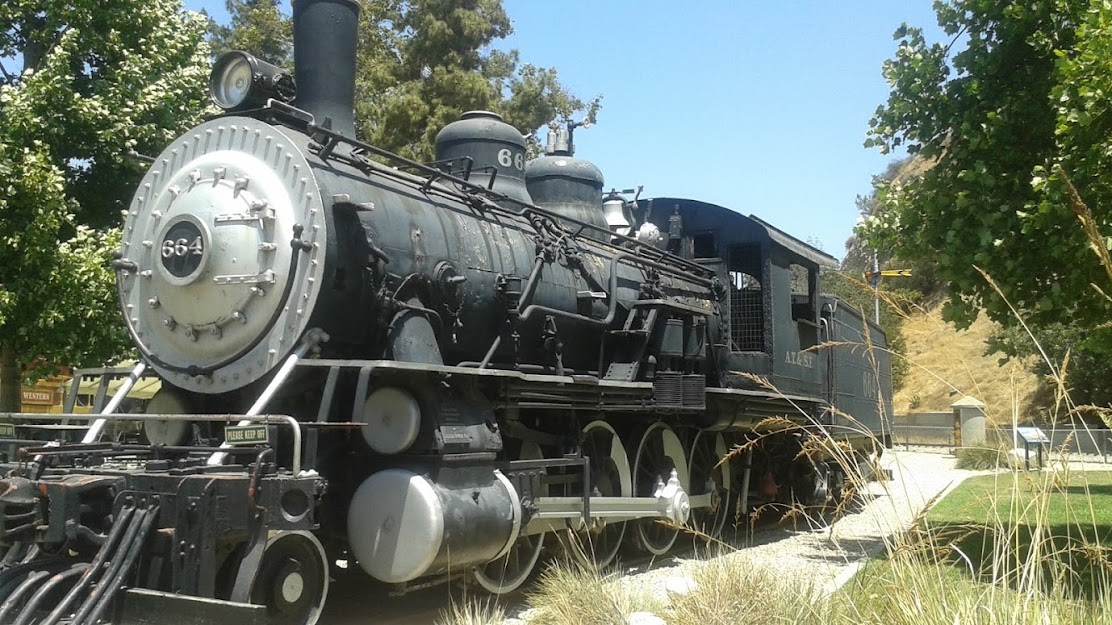
Steam Engine – Rail Road Museum Griffith Park, Los Angeles

Yes, I feel romantic about trains, especially the old steam engines. Maybe that’s why they appear so often in my stories. Trains made it possible to get people and goods to the western United States. In the days of the wagons trains, if it didn’t fit in the wagon, it was left behind.

I have one train ride I plan to do in the future – the Grand Canyon Train. You board the train in Williams, Arizona, and then board the train at their 1909 era train depot. The train takes you to the south rim of the canyon. Spend a day or two at the lodge there and then return to Williams.

Grand Canyon Train at Williams, Arizona

Riding a train with a cup of tea will always bring me joy.

Until next time . . .

The door is always open, and the kettle is always on.

Categories: Uncategorized | Tags: , , , , , , , | Leave a comment

Adventures in the Western Mojave

“I’m sorry.” I can’t tell you how often that is the response when I tell people where I live. They don’t understand that it isn’t the wasteland they’ve imagined.

I live in the Victor Valley of San Bernardino County, in the eastern half of the western Mojave Desert of Southern California. Sometimes called the High Desert to distinguish it from the Low or Sonoran Desert It’s a cluster of small to medium size communities: Victorville, Hesperia, Adelanto, and Apple Valley.

Yes, it is a desert. Yes, it gets hot in the summer (it’s 105o F as I write this today.) In the winter, it can get cold; sometimes there is even snow.

The landscape is vast and covered with low chaparral and Joshua Trees. You know you’re in the Mojave when you see the tall shaggy yuccas. Mountains on the southern horizon can be snow capped from November to March. In the spring, when there is adequate rain we have a fantastic display of color as the desert comes into bloom.

And yes, there are things to do here, in spite of the refrain, “There’s nothing to do here.”

This weekend, I headed west into the Antelope Valley. This is a segment of the western Mojave is in Los Angeles County. These Los Angeles “bedroom communities”, dominated by Lancaster and Palmdale, are still known for agriculture and the aerospace industry.

I needed to take a look at some things as I polish the final draft of The Princess of Sweetwater.

My first stop was in Lancaster at the Western Hotel Museum, operated and maintained by the Lancaster Museum of Art and History. It also is the office for the local genealogy association. Open on the second and fourth Fridays/Saturdays of the month. Admission is free. Built in 1874 the two story structure is the oldest still standing building in Lancaster. As I wandered the hall and climbed the narrow stairs, guided by the docent, Amanda, I could picture my characters spending the night here before crossing the desert.


Hotel

Western Hotel Museum


My second stop was in Palmdale. I headed to the William J. McAdam Park. The park is small and well shaded, but my purpose here wasn’t to have a picnic. On the park grounds is the Old Palmdale Schoolhouse. Built in 1886 (or 1888 depending on source) as the school for the children of Palmenthal (Palmdale’s original name), a German Lutheran community. When the school closed in 1908 it was moved to Lancaster and was a private home, then in 1960 it was relocated to the park. The one-room schoolhouse is in disrepair and cannot be entered, but you can walk around it and peek into the windows from a distance. The architecture is simple with decorations typical of the late nineteenth century. The peeling white and green paint, a reminder of when it acted as someone’s home. From the glimpses I got through the windows, it appeared the two-thirds of the building was the calls room. The back third seemed to be a storage room filled with old desks, but my sources tell me it could have also acted as an apartment of a teacher.


schoolhouse

Old Palmdale School House


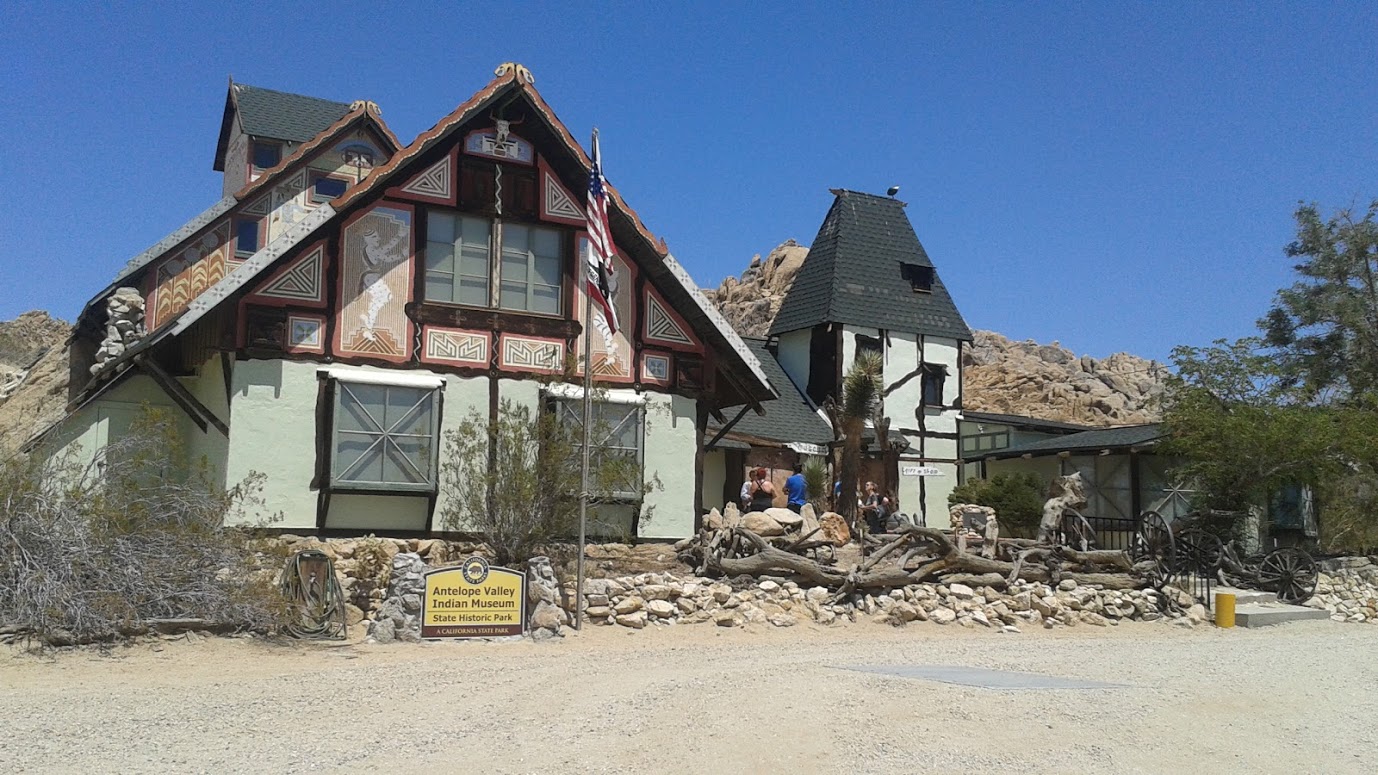
My final stop returned me Lancaster and the Antelope Valley Indian Museum State Historic Park. I hadn’t visited this museum since I was sixteen. At that time the museum was privately owned by Grace Oliver. What I remembered was there were boulders in the main room and it chockfull from floor to ceiling with artifacts. It is now part of the California State Parks system and is open on weekends. Admission is $3.00. The Tudor-revival structure that is built into the rocks was constructed by H. A. Howard in 1928 as his home and incorporated his collection of Native American artifacts in a museum. The museum is very casual with thousand-year-old artifacts sitting out on tables and mantles. The walls painted by Howard are beautiful murals and colorful pseudo-kachinas.


indian museum

The Antelope Valley Indian Museum State Park


The State Park Rangers and the docents are very knowledgeable about the history of the area and the artifacts collected from all over the American Southwest. The docent on duty this weekend was Darrell. He shared the history, showed pictures of the building under construction and answered questions with enthusiasm.

Warning: because to the unique construction of the building you are walking on the rocks of the natural butte. This makes the stairs very uneven, and the museum loft floor, The California Hall, difficult to navigate. With my short little legs, I had difficulty with some of the steps.

There is a short, thirty-minute nature trail also on the grounds. It is best done in the cooler parts of the day in the summer as there is little shade. The sandy terrain is unsuitable for most wheelchairs, but they do have an all-terrain non-motorized wheelchair that you can borrow.


The State Parks schedule weekend and evening activities for families. On the day I was there was a visiting artist from New Mexico with jewelry she had made from ghost beads (juniper seeds), beads and turquoise.

An upcoming event that looks well worth the trip is their annual American Indian Celebration, October 15 and 16.  Admission will be $8.00. There will be artists, musicians, dancers, storytellers, food and kid’s activities. I plan on going; maybe I’ll see you there.

At this point in the day, it’s now getting hot. The weather app on my phone said it was 103o F and the afternoon winds were driving dust devils across the desert floor.

Even though I grew up on the beach, I like living in the desert. There is so much history and natural beauty; you don’t need to apologize. I’m sorry you don’t live here.

Categories: Uncategorized | Tags: , , , , , , , | 2 Comments

Writing In Public


Writing doesn’t have to be a solitary thing.

Most people think of writing as a solitary occupation, with romantic visions of a starving writer holed up in an ivory tower away from the world creating reams of prose and poetry. There are times when we writers do need to be alone with the written word. But that is not always the case.  Sometimes writing and be a very social event.

I write in public. Writing in public is not something non-writers would consider helpful to the writing process. To be honest, I’m not as fast putting word-to-paper in public as I am in my little room at home, but it does garner some interesting conversations.

Why do I write in public? The reasons are many but here’s a few:

It’s a NaNoWriMo thing.

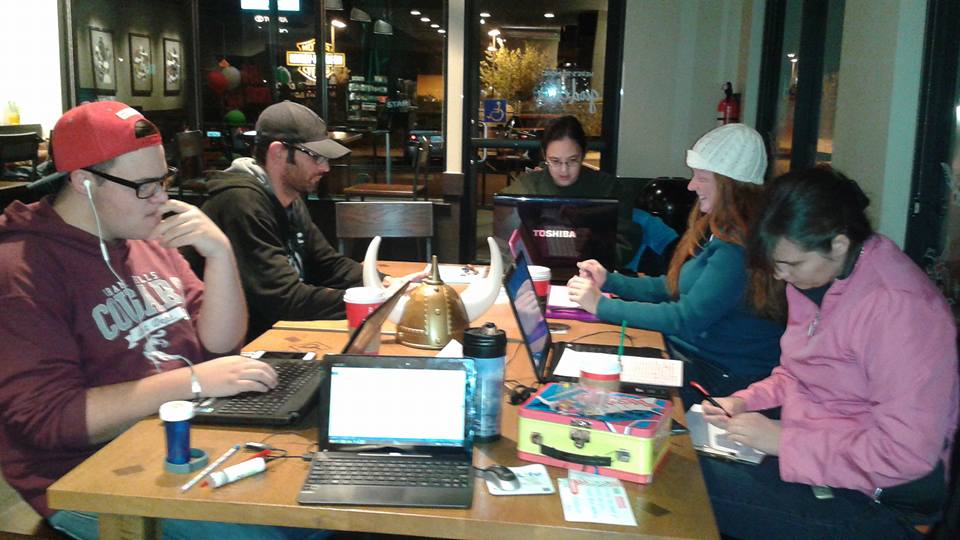
November is National Novel Writing Month (NaNoWriMo), and participants will gather at coffee shops, libraries, and schools to write together for a “Write-In.” The goal is to complete a 50,000 word first draft of a novel in 30 days. Can it be done? Yes, it can. I’ve done it now nine times. Now some of those first drafts may never see the light of day, but I did write them. At a write-in, everyone is working on their own masterpiece in a public space. The gathering may vary from two to twenty people, each typing or hand writing their stories. Not talking to each other, just writing. Then every once in a while there will be a question; for example, in one story I had a character named with the very British name of St. John (pronounced Sinjin) and the question was how do I tell my readers how to correctly pronounce this name? One gentleman in the group suggested that I have someone mispronounce it so the character could then correct him. Problem solved. Back to work! Then there will be the challenges – someone, usually the Municipal Liaison (ML), will yell Word War! And everyone will write frantically for the next ten, fifteen, thirty minutes. The person with the most words during that time wins.

NaNoWriteIn

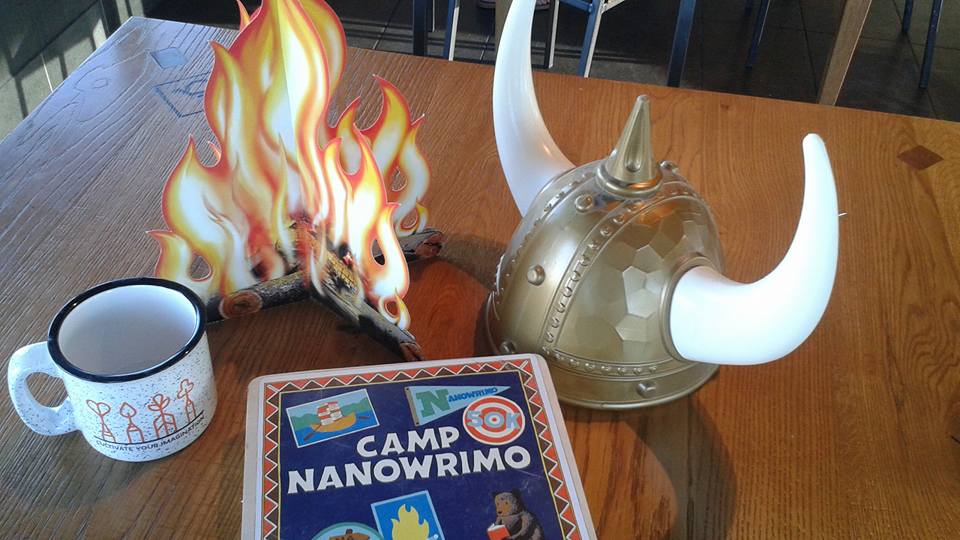
I am the ML for my region, so it’s my job to schedule these write-ins. Plan the challenges – sometimes it’s use this weird obscure word in the next scene or your main character’s house just burned down, now what?  I also provide the prizes, usually small trinkets. I show up early and save the table. No one has any problem finding me, I’m the person in the Viking helmet. When someone comments on my headgear and asks why am I wearing it while I’m typing, it gives me a chance to explain NaNoWriMo and invite them to join in the fun.

As I write this blog, I’m at a write-in, but we’re calling it a “campfire” because July is Camp NaNoWriMo. Earlier while setting up and chatting with the barista, Cory joined in the conversation. He’s a NaNo from Northern California, who just moved into the area. So we pulled up a chair for him, and he joined in the writing, working on his own story.

CampNaNofire

It’s a change of scenery thing.

Sometimes I get bored looking at the same four walls in my writing room. So I pick up my tablet and move outdoors. This being in a new location can be a distraction, and I may get less writing done, but I find inspiration in watching people and listening to the birds.

Some of my outside writing is being in the location of the scene I’m currently writing. For example, for a short story I’m currently working on, it takes place in small mountain town not far from where I live. I spent some time visiting that town. I sat at the local coffee shop, sipped coffee, and wrote the scene that takes place booth next to where I was sitting.

Sometimes I see things that give me ideas for stories. Sometimes I talk to those around me, mostly they’re curious to see someone typing in the park or on the beach. Now I’ve learned what the speech pattern of someone living in that community sounds like and can try to imitate it in print.

It’s things at home are too crazy thing.

Let’s face it working at home isn’t always easy. And even though I have a writing space, things still intrude. The dogs need attention. My husband is watching his beloved Giants trounce the Dodgers and being loud enough the team can hear his support all the way to San Francisco. The phone won’t stop ringing with unimportant calls.

Sometimes my writing room isn’t the fortress of solitude I need it to be. So off to the coffee house or the library I go. I find an unoccupied corner, settle in, and write.

Yes, sometimes I’m interrupted, but I don’t mind. It gives me a chance to talk about writing. To explain why I have pictures of cowboys and Victorian princesses on my notebook – my current novel in progress. To talk about NaNoWriMo and invite them to sign up. To encourage them to check out my friend’s newly published book.

Yes, I write in public. It inspires me. It lets me be social. I can share writing with others.

Until next time, remember the door is always open, and the kettle is always on.

Categories: Uncategorized | Tags: , , , | Leave a comment

Two Ways Dogs Can Make You A Better Writer


Yes, dogs can improve your writing. Actually adding any animal to a story can improve it significantly, but I am a dog parent, I live with two dogs, so I’m going to use dogs.

Furbabies

Argos and Rowdy Girl, my fur-babies.

We’ve all noticed there are people to whom dogs are naturally attracted or just the opposite, they avoid them as if they were the dog-catcher. Dogs are good judges of character. We can also judge a person’s character by how they treat dogs.

This is the first way adding a dog into your story can improve it. We want to let our readers know if this is a “good guy” or a “bad guy,” right? Having them interact with a dog is a way of showing, rather than telling, that the person is gentle or harsh. For example, your main protagonist is eating a hot dog, in walks stay dog (or his girlfriend’s dog), and he ignores the big brown eyes. In fact, he turns his back on the animal. What do we know now? He’s not such a softy after all. Or what if your main antagonist can’t resist taking home every stray dog she finds? Maybe there are some redeeming qualities there after all. What if a character is growled at every time the dog is present? That might be someone who is not trustworthy.

In the above example, the dog is primarily a prop, no different than a gun or umbrella. But a second way to include an animal is as a full-fledged character. There are lots of examples of this. Lassie and Big Red, of course, comes to mind. As does, Buck in Call of the Wild. These are main characters, but they can also be supporting characters. Think of Fang in the Harry Potter and the Sorcerer Stone, Nana in Peter Pan, and Pilot in Jane Eyre. These dogs are not primary characters, but without them, the story would be diminished.

Here are some examples from The Princess of Sweetwater using the dog to tell the reader something:

After dinner, Victoria sat on a stool in front of the big fireplace reading one of the textbooks, while Ox rested his massive head on her lap.

“I have never seen that dog take to someone the way he’s taken to you.” Hiram stretched out in his chair. “Did you have dogs at home?”

“Not as pets. My father keeps deerhounds and wolfhounds, but they’re hunting dogs.”

“Maybe he misses a woman’s attention. Marta spoiled him, and Maria won’t have anything to do with him.”

“You’re always welcome to join me by the fire, big boy.” She buried her face in his thick fur.

Ox is the ranch dog, and he likes Victoria, maybe he’s telling Hiram, she should stick around

And here’s Ox again:

At five o’clock, the boys washed up for supper. They ate in silence. Victoria saw a mix of worry and fatigue in the older boy’s eyes.

As Maria began to clear the table, a dog’s bark mixed with the clinking of the dishes.

“That’s Ox,” said Harvey, shoving away from the table.

He ran to let the dog in, the wind rushed through the open door blew out most of the lamps.

Ox continued to bark and ran back to the barn. Halfway there he stopped and looked back.

“I guess he wants us to follow him,” said Harvey running after the dog.

Victoria and the other boys followed.

On the barn floor, they found Hiram wet, muddy and bloody.

What happened to Hiram? You’re going to have to wait until the book release in March 2017.

english-mastiff-21238305

Ox, an English Mastiff, 150 lbs of slobbering love.

And here’s a cute little beagle named Dudley:

Kate came out of the kitchen when she heard voices in the inn’s main room. The dog bounded after her.  She found two men in suits going through the cabinets and drawers. “Can I help you, gentlemen?”

“We’re from the Pinkerton Agency,” said one of the men. Both pulled out their badges.

Dudley growled at the men. They took a step back.

Maybe Kate shouldn’t trust those Pinkerton agents.

dog-888025_1280

Dudley,  a Beagle pup

And here’s a bonus on how dogs can make you a better writer – owning a dog will get up and moving. You can’t sit at your desk and stare at the computer screen all day. You need a break. Take the dog for a walk, go play in the yard, or visit the pet supply store. While you’re taking that much need break, your brain will still be churning, and when you come back, there will be fresh ideas waiting for you.

Until next time, remember the door is always open, and the kettle is always on.

Categories: Uncategorized | Tags: , , , , | 1 Comment

Oh Look! A Pelican!

Oh look, a pelican!

If you’ve known me any length of time you will know that I am easily distracted by dogs, horses, and birds. If one of these creatures comes into my visual field, you will lose me briefly. One bird, in particular, will capture my attention – the brown pelican.

The brown pelican is a miraculous bird. When I was growing up, they were a rare sight on beaches of Southern California, as their numbers dwindled due to the use of the pesticide DDT. But since the toxin has been banned in the United States the population has rebounded. Just a few years ago I saw a large gathering on the rocks and islets off of coast of Mendocino. Hundreds of them had gathered in preparation for migration. The sight held me mesmerized. I almost forgot to breathe.

When I began writing my novella, Leap of Faith, I wanted to name some of the native animals found on the beautiful islands of the Bahamas. I discovered the brown pelican could be found soaring over the cays of this Caribbean country. So I put one in my story.

pelican-378709_1280

Leap of Faith tells the story of Grace, an administrative assistant, working for a Chicago candy manufacturer. Her life takes an unexpected turn one frosty morning when she is knocked off her feet, literally, by a stranger. Not content to remain a stranger, Philippe Santiago offers her a job on his sugar plantation in the Bahamas.

Here is Grace meeting George, the pelican, for the first time as she arrived on Orchid Cay. An excerpt from Leap of Faith:

As they stood on the dock, their luggage was carried down the gangway and loaded into a lime-green golf cart by the lanky, dark crew members.

A light breeze caressed Grace’s cheek. She took in a deep breath and sighed.

“Are you all right?”

“Yes.” She smiled up at him. “I’m just amazed. The air even smells like vanilla.”

“That would be the wild vanilla orchids that give the island its name.” He put his hand on the small of her back and turned her inland. “It is just a short walk to the house.”

A brown pelican waddled over to her and opened its greedy mouth. Grace didn’t know whether to laugh or cry at the sight of the poor, ungainly bird and its crooked wings.

“That would be George. He was blown onto the cay during a hurricane last year. Xandra nursed him back to life, but he is too badly injured to care for himself now. He follows her around like a puppy. I’m certain she’s still fishing, so he waits and hopes someone, anyone, will give him a fish.”

“Hey, boss,” called a dark, lanky man unloading their luggage, giving them a bright smile. “I got some fresh bait cut in dat bucket. If you want, I can share with George. Then pretty lady be his friend.”

“That’s an excellent idea, Charlie.”

Philippe reached into the bucket, pulled out a large chunk of fish, and handed it to Grace.

She took the slippery fish between her forefinger and thumb, cringing as she held it at arm’s length. She tentatively dropped it into George’s beak pouch, which he quickly snapped shut with a loud clack.

“Oh,” she said jumping back.

“Don’t you worry, George, he not hurt pretty lady.” Charlie laughed. Grace couldn’t help but smile at the man who towered over her. “Give him another piece.”

She gave the bird second bit of fish and this time she was less timid.

“That should keep him happy until Xandra gets home later this afternoon,” Philippe said. “Now, it’s just straight up this path to the house.”

I hope to have Leap of Faith ready for you to read in its entirety very soon. In the meanwhile, sit back and have a cup of tea.

Categories: Uncategorized | Tags: , , , | Leave a comment

Blog at WordPress.com.