Posts Tagged With: #tea

A Victorian/Steampunk Christmas Reading List

With hustle and bustle of the season, sometimes there just isn’t the time to sit back and relax or get done the many things you feel you need to do. This year, I felt the stress of too much to do, and many things were dropped from the list such as baking Christmas cookies and getting my blog done on time. So, I apologize that I’m a bit late getting this out to you.

Winter break is, hopefully, a time to rest and recoup, to celebrate the winter holidays with family and friends, and of course reading. There is nothing like curling up with a good book and cup of tea on a cold winter day. It was the one pleasure I made time for in spite of the pressure “to get things done” that comes with the season.

This year my Christmas reading list took a turn to Victorian and Steampunk genres. Some are short story collections, others are novels, and a few were classics. The hard part is deciding which one to read next.

Author Jessica Lucci with The Snow Globe

First on the list is The Snow Globe and Other Holiday Stories by Jessica Lucci, (Jessica Lucci and Indie Woods, 2021)—a collection of holiday short stories. These stories cover many genres including Paranormal, Romance, Science Fiction, Steampunk, Fantasy, and Contemporary tales. Each of them is fun and every chapter is a self-contained story for when you want something to fill a brief break or to enjoy while waiting for an appointment. This book got me through several doctor appointments with the usual hurry up and wait. The title story is about a successful editor who must face her not-so-happy feelings about Christmas. Not as action-packed as her Tequila Sheila and Other Stories, but still an excellent read.

I had a chance to ask Jessica about her favorite tea. She said that she liked the Ohio Tea Company’s Gingerbread Chai. I haven’t had this tea, but I’ve had others from them. They have many unique blends to satisfy the pickiest tea drinker.

Other books on the list:

The Ghost of Christmas Past, Rhys Bowen, (Minotaur Books, 2017)—This is a Molly Murphy Mystery, but you don’t have to have read others in the series to follow the story. It follows Molly and her family as they celebrate Christmas at an upstate New York estate. It doesn’t take Molly long to realize something isn’t right, that everyone has secrets, and she uncovers the mystery of a missing child to solve. Well worth the reading.

A Christmas Twist: A Twist in Time Book II, Brent A. Harris (Inklings Press 2020)—A sequel to Brent’s A Twist in Time. Based on Charles Dickens’s colorful characters, Oliver Twist and Nell Trent return to face off against ghosts and Ebenezer Scrooge to save the future. This isn’t the A Christmas Carol you’re familiar with. Lots of fun, with time travel and Steampunk elements.

A Snowflake at Midnight: An Elemental Steampunk Tale, Anne Renwick, (Anne Renwick 2019)—Part of the Elemental Steampunk series, this story takes the characters on a Christmas themed adventure. I have just started to read this one, and I am captivated. This Steampunk novel has romance and danger against the backdrop of Christmas.

And of course, we must have a few classic tales.
A Christmas Carol, Charles Dickens (1843)—We’ve all seen the movies, but have you read the original story? There is a richness of language and detail that doesn’t translate to the screen. I re-read this every year.
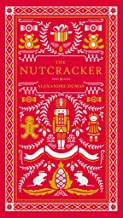
The Nutcracker, Alexander Dumas (1845)—Wait, what? Wasn’t the original story written by E.T. A. Hoffman? And yes, Hoffman wrote “The Nutcracker and the Mouse King” in 1814. The story wasn’t well known until Dumas took Hoffman’s little story and expanded it. It was this version that Tchaikovsky’s ballet is based on. I love both versions and will read one or both every year.

I’m working my way through the list with a hot cup of tea and a Christmas cookie or two.

What’s on your Christmas reading list?

Until next time remember, the door is open, and the kettle is on.

Categories: Uncategorized | Tags: , , , , , , , , , , , | 2 Comments


The Brass Queen

This is it, my one moment to shine. I’ll make them all love me or die trying. Nothing and nobody will stop me from—Her face slammed into a muscular chest.

(How Miss Constance Haltwhistle and Mr. J.F. Trusdale met, and so began their adventure.)

Take a red-headed arms dealer in a chainmail corset, an American Spy in a cowboy hat, invisible assassins, and a murderous prince in a world powered by steam, and you have the makings of an odd-ball steampunk romance. Elizabeth Chatsworth, a Yorkshire-born writer living in Connecticut, has created a fun romp through the English countryside with her book, The Brass Queen (CamCat Books 2021).

The author, Elizabeth Chatsworth

 I ordered the Brass Queen after meeting Elizabeth at the online C.O.G.S. Steampunk Expo earlier this year. She was engaging and enjoyed talking about steampunk and writing. During on panel, she read a chapter from her book. Intrigued, I had to order a copy. I wanted to see what further trouble Miss Constance Haltwhistle and Mr. J.F. Trusdale would find themselves in, and most importantly, how were they going to survive?

The story begins with Constance hosting her own coming-out party because she needs a husband quickly or loses her estate. Things don’t go according to the plan (that’s Plan with a capital P.) Despite things going awry, with the help of her loyal family retainers and the “American spy” Trusdale, she manages to make it through the day.

You can’t help liking Constance, even when she is being stubborn about the Plan. She doesn’t give up and makes it work. She is definitely not a shrinking violet waiting to be rescued by the handsome hero.

And what can I say about Trusdale? Like Constance, he has his own secrets, and he becomes all the more lovable with each reveal. And he cuts a fine figure covered in soap bubbles (you’ll just have to read the book.)

Another thing I like about this book is how she separates the three point-of-view (P.O.V.) characters: Constance, Trusdale, and Prince Lucien. Each chapter has a single P.O.V., making the narrative easy to follow.

When talking to Elizabeth, she said her favorite tea is P.G. Tips. This is sometimes called “builder’s tea” due to it being a stronger tea. According to the box, “England’s No1 Tea.” This was the tea Elizabeth drank in her hometown of Sheffield, Yorkshire, England. I have seen this tea in the store, but until now had never tried it. On Elizabeth’s recommendation, I brewed a pot and served it with milk. Personally, I liked it. Yes, it’s strong, perhaps a bit much for my afternoon cup but excellent for the morning. It is stronger than the “orange pekoe” most Americans are used to drinking. Some may prefer it with a bit of sweetener.   

I highly recommend The Brass Queen by Elizabeth Chatsworth. Also, keep a lookout for the sequel The Brass Queen: Grand Tour, scheduled to be released in 2023.

An independent bookstore

I purchased my copy of The Brass Queen from Mysterious Galaxy and Books, an independent bookstore in San Diego. So, when buying books this holiday season, please consider supporting your local independent bookseller.

Categories: Uncategorized | Tags: , , , | 1 Comment

Rabbits and Writing

“Ideas are like rabbits. You get a couple and learn how to handle them,

and pretty soon you have a dozen.”

 John Steinbeck

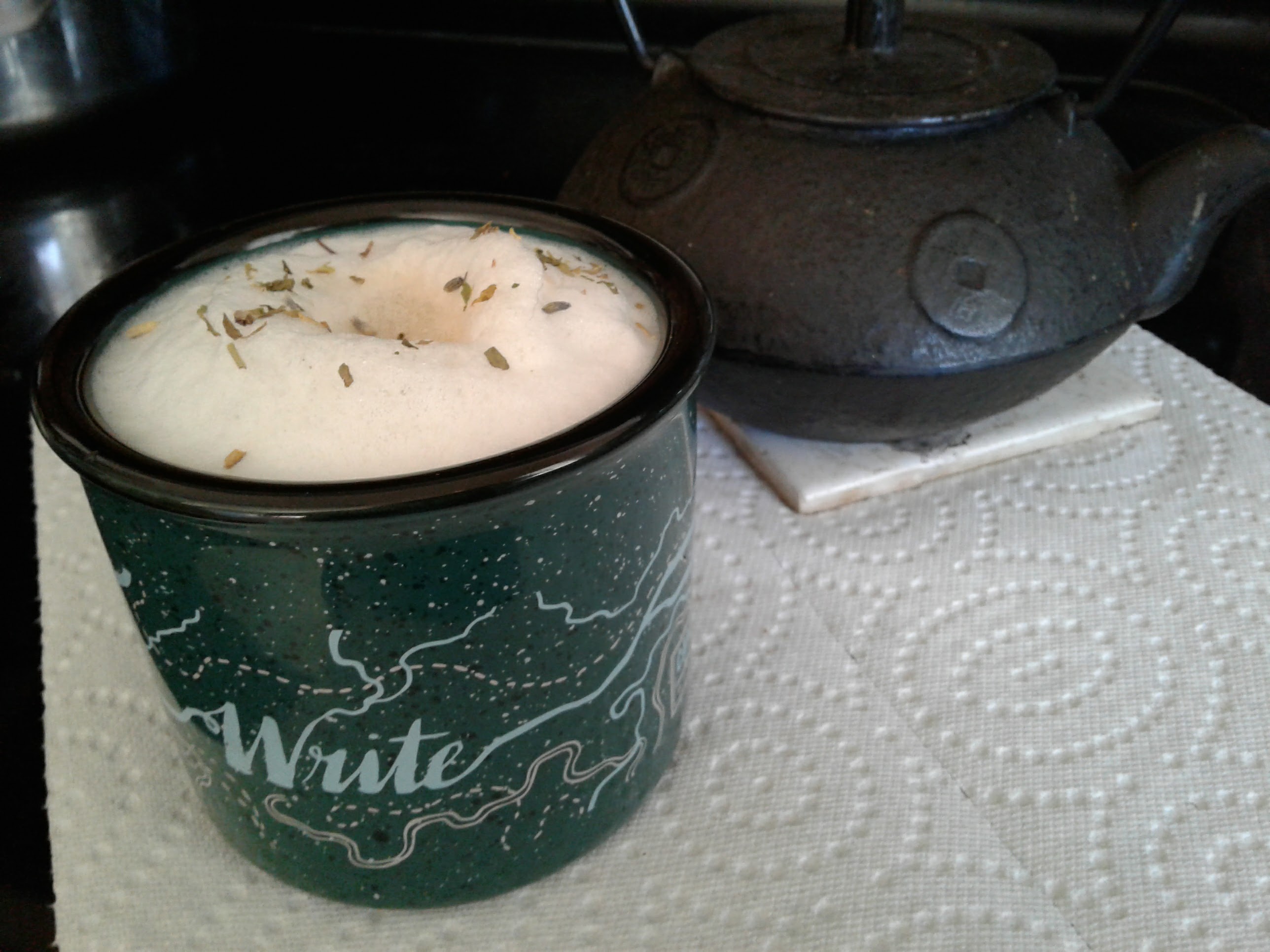
As a writer and a storyteller, friends ask me questions about my writing process. With my London Fog Latte in hand, I’m going to answer some of those questions.

Where do you come up with your ideas?

Like Mr. Steinbeck’s rabbits, I find ideas can come from anywhere: a photo, an overheard conversation, or a museum display. My favorite source of ideas is woolgathering. As Joyce Carol Oates said, at the 2017 LA Times Festival of Books, “Only for the writer is wool-gathering work.” Just letting my mind wander in the forest of my imagination, I find wonderful people and events. And when I find one, I add it to my list.

In the case of The Princess of Sweetwater, I was muddling about looking for an idea for my 2011 National Novel Writing Month (NaNoWriMo) project. Earlier that year, I had gone the Antelope Valley Alfalfa Festival and Fair and visited the Antelope Valley Rural Museum on the grounds. I learned about ranching and farms during the area in the late 1800s from the displays. A few weeks later, I was watching my favorite movie for the hundredth time, Roman Holiday. Now the wool-gathering begins. What if a princess ran away in 1886 and came to the Antelope Valley? What if she fell in love? What if she was forced back home against her will?

The Western Hotel Museum

The Western Hotel Museum, Lancaster CA – The inspiration for one of the story’s locations.

Are you a plotter or a pantser?

I’m not a plotter/planner in the strict sense of the word. I research the historical period, I study maps, and I visit the locations.  I do write an outline, but it is a simple one with just the main plot points noted. Some plotters, when done with their outline, have a ten-page plot synopsis with every detail listed. I do plan, but I also discover my story as I write. The outline is just a roadmap, and if I find an interesting detour, I’ll follow it and see where it leads. In this, I share traits with the discovery/intuitive or pantser writer. I am a hybrid. When I reach the end of my first draft, the story may be very different than I first envisioned it during the outlining stage.

When do you edit/revise?

Until I finish the first draft, I do very few revisions, if any. I just put the story down with its awful and awkward scenes, misspelled words, and grammatical errors. But that’s okay; it’s the first draft. I just want to get the idea down on paper and resist the urge to go back to revise and edit.  James Scott Bell wrote in his book Revision & Self-Editing, “Give yourself permission to be bad. Write first, polish later.”

If I find I’ve drifted off the main road and it will require a change in a previous scene, I make a note in a different color to remind me to fix the continuity. If I find a scene no longer will fit, I don’t delete it. I line through it, so I can still see it, because during revisions I may find it works better elsewhere.  I do set a daily goal. If during NaNoWriMo, it’s 1750 words a day to make the 50,000 words by the end of November. Over the rest of the year, my daily goal is three pages or about 900 words. If I stopped to revise, I’d never make the deadline. When I finished the first draft of The Princess of Sweetwater, I had 50,613 words of which a third would find themselves chopped when I began to edit. The first draft was just a skeleton, with only Princess Victoria’s story told, no backstory, a flat male protagonist, and no subplots.

I’ll admit edits and revisions are hard work and painful. I start by reading the manuscript and find I have plot holes big enough to drive a stagecoach through. Despite the pain, I chop and rewrite.  As Stephen King wrote, “Kill your darlings, kill your darlings, even when it breaks your egocentric little scribbler’s heart, kill your darlings.” Sometimes it’s the best thing you can do. I cut out several lovely scenes in The Princess of Sweetwater, beautifully written, but they did nothing to move the plot forward and as a result had to go.

 Do you let others read your stories in progress?

I do have readers for my work-in-progress (WIP). I have Alpha Readers. These are fellow writers who help me shape the work as I am writing the first draft and before any serious revisions start. Often, they give me a hand with finding kinks in the plot, to avoid dead ends, and discovering something that was missing.

My Beta Readers review the manuscript when it is finished. These are readers who love the type of stories I write and will be honest with me if something doesn’t work, or if I’m just wrong about a historical fact. I choose some Betas because of their expertise in the era or industry used in the story. Their comments help me tighten the story before I sent it to a professional editor.

 Of course, at some point in the process, my husband reads it and gives me his thoughts and corrections.

How long does it take to write a novel?

The process of writing is different for every writer. In the case of The Princess of Sweetwater, it has been a long journey from its beginning in 2011 to now.  (I don’t say the end because the end is publishing and marketing.) Part of that is due to me setting the book aside to give me a break from it. Sometimes I need to step away from a project to see it with fresh eyes. After each revision, I tucked Princess Victoria and her friends away until I could return to them later.

Are you going to self-publish?

At this point, no. I am in the process of submitting The Princess of Sweetwater to agents.

How do you handle writer’s block?

I don’t. Writer’s block happens when you sit around and wait for inspiration to arrive. But as Jack London said, “Don’t loaf and invite inspiration; light out after it with a club, and if you don’t get it you will nonetheless get something that looks remarkably like it.” So even if I don’t feel like it, I make myself write every day. It may end up being poor writing but as Jodi Picoult said, “You can always edit a bad page. You can’t edit a blank page.”

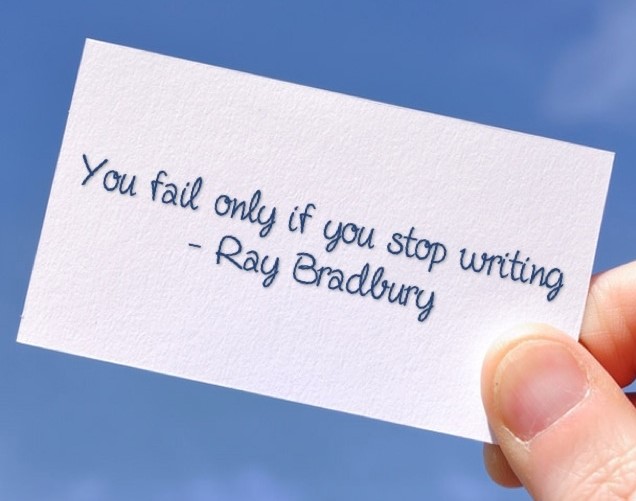
For inspiration, I have a sign on my desk that reads, “You fail only if you stop writing. – Ray Bradbury.”

2cd24e6aec27e742bddd078197837ebb--writing-ideas-writing-quotes (2)

What is a London Fog Latte?

A London Fog Latte is a latte made with Earl Grey Tea and steamed milk.

Ingredients:

  1. 1 cup (8 oz) strongly-brewed Earl Grey Tea (I add a pinch of dried lavender, optional)
  2.  1/2 cup (4 oz) steamed or scaled milk (any kind)
  3. 1 Tbsp. simple syrup,  granulated sugar, or sweetener of your choice (adjust to taste, I often leave it out entirely.)
  4. 1/4 tsp. vanilla extract

After steeping the tea and lavender, pour into a cup and add the other ingredients. Stir gently. Enjoy.

20170923_093622.jpg

Until next time . . .

The door is always open, and the kettle is always on.

Categories: Uncategorized | Tags: , , , , , , , , , , , , , , , | 1 Comment

You had me at tea.

I wouldn’t consider myself “a foodie,” at least not in the true sense. I don’t take pictures of everything plate of food I consume. I don’t write about most of the places I’ve gone to eat. I do enjoy my food. I eat well. I have the womanly curves to prove it.

There is one food experience that I really enjoy, that is going to the local Farmer’s Market. It is sensory overload with all of the fresh produce. The colors are bright, the air is pungent, there is something good to taste at most of the booths.

I don’t get to visit my local Farmer’s Market as often as I would like. It is held every Thursday morning on the lower campus of Victor Valley Community College. The timing is such, that when school is in session, I am unable to attend. During the school year, I sent a friend with a shopping list, and he picks up my fruit and veggies. In the summer, I’m there as often as I can.

When I first enter the market area, the first thing is the booths of vendors selling non-food items. These can range from Tupperware and Avon products to clothing and home decorations. I just scoot on past those, I’m here for the yummy stuff.

Wandering deeper into the market, I could start smelling the fruit and herbs. I meandered through tasting samples and making purchases. Bread from a San Bernardino bakery. Kale, broccoli, and rosemary from a Fresno grower. Blueberries and loquats from a Riverside grower.

shopping

My shopping.

Then I found the tea vendor from Big Bear.

Tea, loose leaf tea, tea blended by Mr. Wright and his wife.

The proprietor of Mountain Witch Tea greeted me warmly. He opened bags and let me savor the sweet and spicy scents.

Mr. Wright then asked me what kinds of tea I enjoyed. When I told him my favorite was Earl Grey with a touch of lavender, he pulled out a bag of their Earl Grey Tea – black tea, rosemary, lavender, rose and bergamot oil. It smelled of citrus and flowers.

We chatted about history, the health benefits, and the variety of teas. I mentioned the smoked souchong tea I had tried in Boston. He often carried that tea, apparently it’s really popular in the mountain communities. He promised to bring some down next week for me. (Yippee!)

I picked up the Cherry Blossom Tea. With his permission, I opened it. Sweet and fruity, it reminded me tea at the Japanese Friendship Garden in Sand Diego. It contained black tea, rose petals, vanilla bean and cherry flavor.

With two black teas chosen, I turned to his green and herbal teas. I had lots of choices – I debated between the Moroccan Mint and the Angel Wing White Tea. I chose the white tea, this is a tea I was unfamiliar with and thought I should give it a try. “white tea” are tea leaves picked while still young and still unfolding.

Tea bags

My tea.

With my shopping bags full and my wallet empty, I schlepped back to the car and home. Of course, once back at the house, the job wasn’t done. I had vegetables to clean and store, the fruit to put in the bowl, and a pot of tea to brew.

Now as the temperature threatens to sneak over a hundred degrees, I might not get much else done today. That’s okay, it was a lovely morning, and I have tea in my cup.

tea cup

Earl Grey in my colonial style tea cup from Boston.

Until next time, remember the door is always open, and the kettle is always

Categories: Uncategorized | Tags: , , | 2 Comments

Journey to Boston: Part One

Journey to Boston: Where America Begins

This past week I was blessed with a visit to Boston, Massachusetts. It is a great city with three hundred and eighty-six years of history, making it one of the oldest cities in the United States. In this three-part series, I will share some to the highlights of my three days wandering the streets of Boston. Each will feature a place or two that I visited and one meal. Come join me on the journey.

Part One: Ships and Tea Parties

Boston is really where the story of the United States begins. It was the home of John Hancock, Samuel Adams, John Adams and Paul Revere. Benjamin Franklin was born in Boston, though he later made his home in Philadelphia. The first shots of the American Revolution could be heard in Boston, but I’m getting ahead of myself.  In the 1870’s a series of events would change a group of British colonies into a united independent nation. One of these events would become known as the Boston Tea Party. On December 16, 1773, ships, taxes, and tea collide. That night a group of young men, calling themselves the Sons of Liberty and disguise loosely as Mohawk Indians, snuck aboard three ships and dumped their cargo of East Indian Tea into the harbor. The act lead to the blockade of Boston harbor nearly starving the residence of the city. Other colonies united in support of Boston leading the way toward them working together for independence.

Due to dredging, which has enlarged the city significantly, the original location of the wharf is high and dry. Today you can visit a new pier within a few yards of the original Griffin’s Wharf, home of the Boston Tea Party Ships & Museum.

Upon entering the “Old South Meeting Hall,” I was greeted by Benjamin Burton (played by Armando). He gave me an identity of one of the Sons of Liberty – a role I would play during the interactive program.  From there, in our Mohawk disguises, we went aboard the Beaver and destroyed the tea. This was followed by a multimedia presentation about the aftermath of these events and how they produced the foundation for the unity of the colonies.


IMGP2189

Benjamin Burton calling the meeting at the Old South Meeting Hall, Dec 16, 1773.


One of the highlights for me was seeing one of the two known remaining tea boxes from that night. This simple wooden cube had been saved and passed down the generation of one family. When I saw it I thought it was very much like the one I had seen at the National Portrait Gallery Washington D.C. in 1975. It actually was the same box! The Robinson Half Chest (as it is called) had been on display there before being moved to the Tea Party Ships & Museum as part of their permanent collection.


IMGP2191

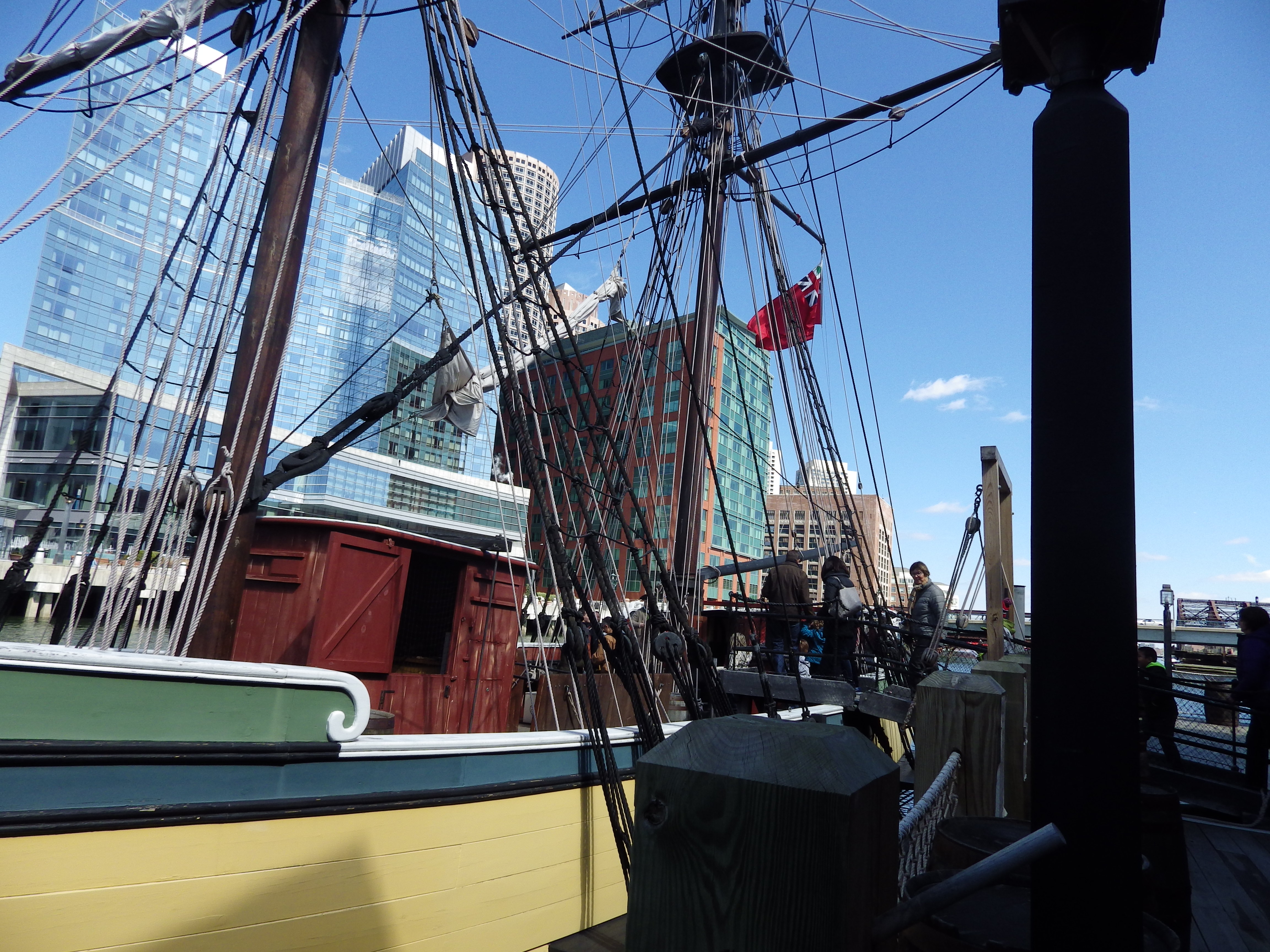
A replica of the Beaver, one of the three ships carrying tea. 


The visit didn’t end there. After the tour, Mr. Burton led the group to Abigail’s Tea Room. He introduced us to Mercy Scollay (played by Diana). In the tea room were lunch items, sweets, and tea for purchase. The tea room highlighted samples of the five teas that would have been on board the three ships that night.

With my tea cup in hand, I sampled the teas.

First up was Souchoung. Made from the older larger leaves of Camellia sinensis, they are smoked of over pinewood fire before they are fermented to make a strong black tea. It was one of the more popular teas during the colonial period. Miss Scollay warned me this was a tea that “you’ll either love or you’ll hate.” It was not like anything I had tasted before. This tea was very strong and had a smoky taste. It was like drinking barbecue.

The second was another black tea, Congou. This tea was one of the more expensive teas and was served in the more elite homes. It was full-bodied and well-balanced tea, reminding me of a very good English Breakfast.

The third was the last of the black teas, Bohur Blu. This was the least expensive of the black teas and would have been found in most homes before the passing of the 1773 Tea Tax. The taste on the bitter side and reminded me of your basic tea bag from the grocery store.

The last two teas were green teas. This surprised me. I asked Miss Scollay about this, thinking it rare for green tea to be found outside of Asia at this time. She said that the shipment on the ships destroyed during the Boston Tea Party would have been the first shipment to colonies.

The first of these green teas was Young Hyson. This tea was said to be Thomas Jefferson’s favorite and that he served it at the White House during his presidency. It was a light flowery tea that reminded me of jasmine green tea.

The final tea was Singlo. Picked later in the season, when the leaves are larger, this green tea was a very strong. It reminded me the tea served in Japanese restaurants today.

After sampling the teas, I poured myself a full cup of the Congon to drink with my cranberry-orange scone. As I enjoyed my refreshments, I continued to chat with my new friends. Diana and Armando broke character to tell me about their work. They told me most of the cast were either professional actors or historians. They truly enjoyed working at the Boston Tea Party Ships and Museum, especially with school groups come to visit. The interactive-multimedia presentation “brings the story to life, makes it real for them,” explained Armando.


IMGP2201

Benjamin Burton and Mercy Scollay, Abigail’s Tea Room


I enjoyed my visit to Griffin’s Wharf. A special thank you to Diana and Armando for sharing their time and knowledge with me.

Coming soon:

Part II: Sailors, Brownstones, and Pasta.

Part III: Trollies, Trails, and Seafood

Categories: Uncategorized | Tags: , , , | 2 Comments

Blog at WordPress.com.