Uncategorized

You had me at tea.

I wouldn’t consider myself “a foodie,” at least not in the true sense. I don’t take pictures of everything plate of food I consume. I don’t write about most of the places I’ve gone to eat. I do enjoy my food. I eat well. I have the womanly curves to prove it.

There is one food experience that I really enjoy, that is going to the local Farmer’s Market. It is sensory overload with all of the fresh produce. The colors are bright, the air is pungent, there is something good to taste at most of the booths.

I don’t get to visit my local Farmer’s Market as often as I would like. It is held every Thursday morning on the lower campus of Victor Valley Community College. The timing is such, that when school is in session, I am unable to attend. During the school year, I sent a friend with a shopping list, and he picks up my fruit and veggies. In the summer, I’m there as often as I can.

When I first enter the market area, the first thing is the booths of vendors selling non-food items. These can range from Tupperware and Avon products to clothing and home decorations. I just scoot on past those, I’m here for the yummy stuff.

Wandering deeper into the market, I could start smelling the fruit and herbs. I meandered through tasting samples and making purchases. Bread from a San Bernardino bakery. Kale, broccoli, and rosemary from a Fresno grower. Blueberries and loquats from a Riverside grower.

shopping

My shopping.

Then I found the tea vendor from Big Bear.

Tea, loose leaf tea, tea blended by Mr. Wright and his wife.

The proprietor of Mountain Witch Tea greeted me warmly. He opened bags and let me savor the sweet and spicy scents.

Mr. Wright then asked me what kinds of tea I enjoyed. When I told him my favorite was Earl Grey with a touch of lavender, he pulled out a bag of their Earl Grey Tea – black tea, rosemary, lavender, rose and bergamot oil. It smelled of citrus and flowers.

We chatted about history, the health benefits, and the variety of teas. I mentioned the smoked souchong tea I had tried in Boston. He often carried that tea, apparently it’s really popular in the mountain communities. He promised to bring some down next week for me. (Yippee!)

I picked up the Cherry Blossom Tea. With his permission, I opened it. Sweet and fruity, it reminded me tea at the Japanese Friendship Garden in Sand Diego. It contained black tea, rose petals, vanilla bean and cherry flavor.

With two black teas chosen, I turned to his green and herbal teas. I had lots of choices – I debated between the Moroccan Mint and the Angel Wing White Tea. I chose the white tea, this is a tea I was unfamiliar with and thought I should give it a try. “white tea” are tea leaves picked while still young and still unfolding.

Tea bags

My tea.

With my shopping bags full and my wallet empty, I schlepped back to the car and home. Of course, once back at the house, the job wasn’t done. I had vegetables to clean and store, the fruit to put in the bowl, and a pot of tea to brew.

Now as the temperature threatens to sneak over a hundred degrees, I might not get much else done today. That’s okay, it was a lovely morning, and I have tea in my cup.

tea cup

Earl Grey in my colonial style tea cup from Boston.

Until next time, remember the door is always open, and the kettle is always

Categories: Uncategorized | Tags: , , | 2 Comments

Memorial Day, a Day of Rememberance

Please don’t wish me a happy Memorial Day. Please don’t thank me for my service today. Today isn’t about celebrating the first weekend of the Summer Session or fantastic deals at the mall. Today is a memorial service, a funeral of sorts.

memorial-day-354082_1280

Let me explain.

Today, I went to the Victorville Memorial Park as requested by my American Legion post to participate in the Memorial Day ceremony. While waiting for it to begin, I had a conversation with Rene De La Cruz, a reporter for the Victor Valley Daily Press. We discussed the meaning of the day and the “celebrations” we saw, and frankly, we found it a little disturbing.

We have three holidays to honor our military. Veteran’s Day, a day of giving thanks and honor to those who have served during all of the wars and conflicts. Armed Forces’ Day, a day to celebrate and encourage those currently on active duty, a holiday that is largely forgotten. And Memorial Day, a day to remember and honor those who paid the ultimate price and gave their life in service to us, the people of the United States of America.

Memorial Day came out of the Civil War. General John Logan, Commander of the Grand Army of the Republic, gave this order: “The 30th of May, 1868, is designated for the purpose of strewing with flowers, or otherwise decorating the graves of comrades who died in defense of their country during the late rebellion, and whose bodies now lie in almost every city, village and hamlet churchyard in the land.”

He called it Decoration Day and chose the date because it wasn’t the anniversary of any particular battle. And at the first Decoration Day, General James Garfield (and future President) gave a speech at Arlington National Cemetery. That day 5,000 came to decorate the graves of 20,000 Union and Confederate soldiers buried there.

The day became alternately known as both Decoration Day and Memorial Day, the name was not official until 1968. It was fixed to the last Monday in May, rather than the 30th, in 1971.

Okay, history lesson over.

For me, Memorial Day is a somber day. A day I approach with a tear in my eye and a heavy heart.

I remember as a child, there were friends whose fathers, uncles and older brothers didn’t come home from Vietnam.

I remember friends and colleagues that didn’t come home from Desert Storm, during my time on active duty.

I remember friends whose sons and daughters, brother and sisters, wives and husbands haven’t come home from the current conflicts.

I remember my great-grandfathers, who served in World War I. Great-grandpa Kimball, my maternal grandmother’s father, never made it home, he was one of the many soldiers and sailors who died in the flu pandemic at the end of war. He died and was buried at Portsmouth Naval Hospital, Portsmouth, Virginia (His last “duty station” was my first.) Great-grandpa Nelson, my maternal grandmother’s step-father, was a shipmate of Great-grandpa Kimball’s and told wonderful stories about him.

Great-grandpa Nelson, “Gramps” as we called him, loved it when we would recite poems to him. In Flander’s Field by John McCrea, was a favorite of his. I memorized it and recited at a school Memorial Day assembly when I was in junior high school.

IN FLANDERS FIELDS
by Lieutenant Colonel John McCrae (1872 – 1918) Canadian Army Medical Corp

In Flanders fields the poppies blow
Between the crosses, row on row,
That mark our place: and in the sky
The larks still bravely singing fly
Scarce heard amid the guns below.

We are the dead: Short days ago,
We lived, felt dawn, saw sunset glow,
Loved and were loved: and now we lie
In Flanders fields!

Take up our quarrel with the foe
To you, from failing hands, we throw
The torch: be yours to hold it high
If ye break faith with us who die,
We shall not sleep, though poppies grow
In Flanders fields

Composed at the battlefront on May 3, 1915, during the second battle of Ypres, Belgium

poppy-field-1411886_1280

On this day, remember those you gave the greatest measure and sacrificed themselves so you can spend the day sunning yourself on the beach, go to the mall and live your life without fear.

Until next time remember – the door is always open, and the kettle is always on.

Categories: Uncategorized | Tags: , , , , | 4 Comments

Piatigorsky International Cello Festival

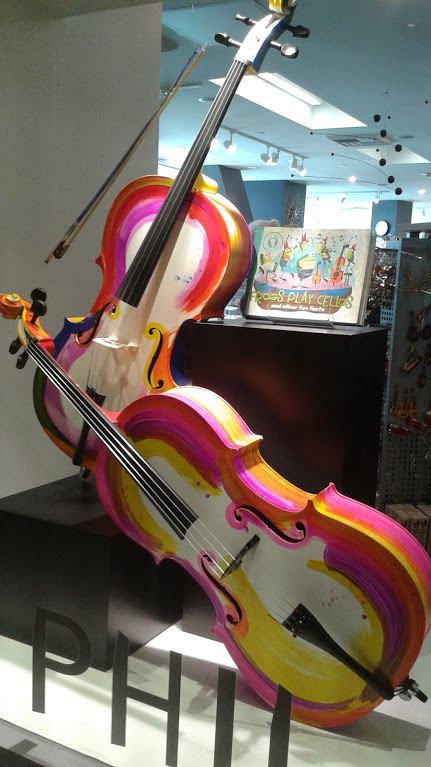
cellos

A little more than a week ago I had the opportunity to participate in the Piatigorsky International Cello Festival.  No, not as a cellist, but as a member of the audience. This festival founded by Ralph Kirshbaum honors cellist Gregor Piatgorsky  (1903 – 1976) with concerts, recitals, and master classes all lead by the great modern cellist (Zuill Bailey, Yo-Yo Ma, and Li-Wei Qin just to name a few). The events are sponsored by the Los Angeles Philharmonic and the University of Southern California. Nearly a hundred events throughout its two-week run I couldn’t attend all of them, so I picked one day.

I went on a Sunday when two concerts were scheduled. At mid-morning, I pointed my car southwest and headed the hundred miles to Los Angeles and Walt Disney Concert Hall.

I arrived ninety minutes before the performance and headed straight for the lecture hall. The conductor Leonard Slatkin spent some time talking about his life and the music we would be hearing. He shared how as a child his world was full of music. He was tucked into bed with lullabies sung by Uncle Frank (as in Frank Sinatra). He also took a few minutes to teach the two hundred or so of us, how to conduct an orchestra. He said it was the easiest job in music. When he was done, it was time to find our seats.
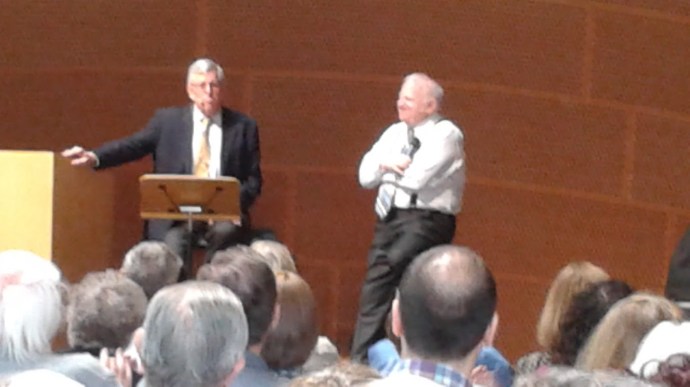
Leonard

I had a climb to find my seats. I was high in the upper balcony giving me an expansive view the auditorium and the stage. To my delight, I had friends sitting nearby. The lights dimmed, and the music began.
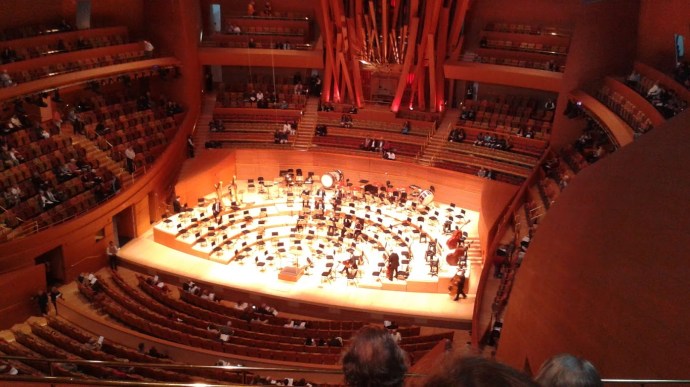
from the balcony

The first piece was the Overture to William Tell by Gioacchino Rossini (1792 – 1868). I had learned from Mr. Slatkin that Rossini was a cellist. Most of you will be familiar with this piece. One passage became the theme The Lone Ranger and another was used in the short film Bambi Meets Godzilla. What many may not remember, including me, the opening bars are a cello solo, played by the principle cellist, in the case the sublime Robert DeMaine. He was then joined by three more cellos before the full orchestra joins in. Beautiful and pastoral, it is always fun to hear it again.

The second piece on the program was Cello Concerto No.1 by Bohuslav Martinů (1890 – 1959). The soloist was the beautiful Sol Gabetta, dressed in a long flowing red gown. I sat with anticipation to hear a cellist I was unfamiliar with playing a piece by a composer I was that was also new to me. The program informed that this would be the first time the LA Phil had performed the piece. It was new to all of us.  The themes ranged from robust and rhythmic to austere and noble.

Gabetta played one encore. Unfortunately, up in the balcony, we couldn’t hear what was announced from the stage. But it was unique. Played mostly with harmonics it was high pitched and hauntingly beautiful.

After a short intermission, we returned to hear Symphonie Fantastique: Episode in the Life of an Artist by Hector Berlioz (1803 – 1869). This piece uses music to tell the story of love found, love unrequited, and love lost. Some of the themes were very tender and bittersweet and others like the “Dream of a Witch’s Sabbath” were wild and yet sad.

When the concert ended, I had a picnic on the front steps. I had hoped to eat in the lovely public garden at Walt Disney Concert Hall but is was closed between performances.

When the auditorium reopened, I headed to my seat. This time a bit lower in the terrace section, these seats put you just above eye-level with the stage.
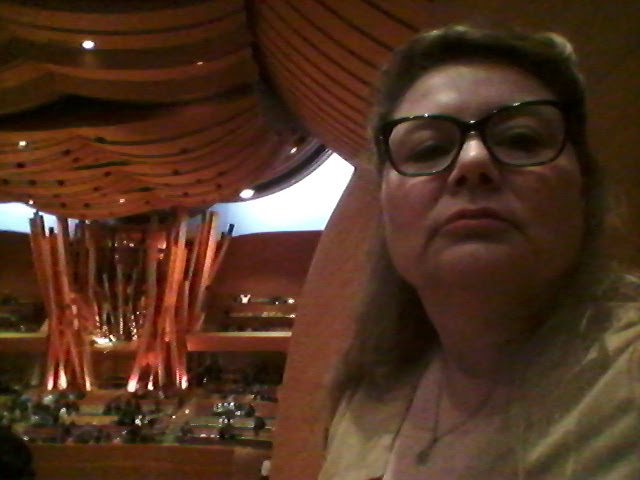
from the terrace

The was a recital, only two performers would grace the stage. On cello, Yo-Yo Ma, and on piano, Kathryn Stott. In evening attire, they took the stage silently, bowed, and began to play.

The first pieces played as a single suite, were from their album Songs from the Arc of Life. The suite is a collection of their favorite pieces from the album, which reflects points along a person’s life. It began with the Ave Maria (Bach/Gounod), followed by Was it a dream? Op. 37, No. 4 (Sibelius), Tango Jalousie (Gade), Beau Soir (Debussy), and ending with Ave Maria (Schubert).  They moved seamlessly between each piece. I had tears in my eyes.

The next piece was Sonata in D Minor, Op. 40 by Dmitri Shostakovich (1906 – 1975). This is one of my favorites from the cello repertoire.  With three fast movements and a slow one squeezed between the second and the forth, it is a roller-coaster ride. The end of the second movement was climatic the audience burst into applause (It generally frowned upon to clap between movements.) The slow or Largo movement was graceful. The final movement again fast and forceful.

During the brief intermission, my seat neighbors asked me if I had seen the look the lady in front of me had shot my why when I unwrapped a throat lozenge.  Yes, I had. She had been given all around her sharp looks and shushing for the smallest of noises. I can only imagine her response if I had not chosen to sooth my tickle and coughed.

When the program continued, Yo-Yo Ma returned to the stage in a gray t-shirt. He made a joke about it being warm on stage. He modeled it, turning so we could see the cello festival logo and the list of performers.

The next piece was Il bell’Antonio (Tema III) by Giovanni Sollima (b. 1962). This is another selection from Songs from the Arc of Life. This was a fun contemporary arrangement made all the more special in that the composer was sitting in the audience. From my seat, I could watch him listening to his music being played.

The final official selection for the evening was Sonata in A Major by César Franck (1822 – 1890). This was originally written for violin, but transcriptions for cello and flute were also published during Franck’s life. I enjoyed listening to this arrangement. I thought it was appropriate that the last piece I would hear this session was also played in the first concert I attended, during Joshua Bell’s concert back in October. The two not only had different instruments (Bell plays the violin), they also approached it differently. Bell attacked the notes and danced his way through it. Ma caressed the notes and gently wove his way through it.

The performance didn’t end the. Ma and Stott did three encores. All from the Songs from the Arc of Life Lullaby: (Wiegenlied, Op. 49, No. 4), Salut d’Amour, Op 12, and The Swan (from Carnival of the Animals). Ma raised his arms and flapped like a bird to announce The Swan, sending chuckles through the audience and another round of dirty looks from the lady in front of me.

Oh, did I mention the page turner? This young woman had the task of turning the music pages for Stott. This is a difficult job. The page turner rarely gets more than a few minutes before the performance to discuss how the pianist wants the page turning done. And every one of them has their unique preferences. During the show, her eyes never left the music. She stayed focus. Nothing distracted her from her task – no the noise coming from the audience, not the beauty of the music. I know I couldn’t do it. I would have gotten lost in the sheet music or starting listening to them play. Kudos to her on a job well done.

It was an enjoyable day. The only part that wasn’t fun was the ninety-minute drive back to the High Desert. Would I do it again? Do ducks fly south in the winter? You bet I would. I’m already contemplating how I could attend more of the festival’s events next year.

Until next time, remember the door is always open and the kettle always on.


Categories: Uncategorized | Tags: , , , , , , , , | 1 Comment

Huzzah! It’s Ren Fair Time.


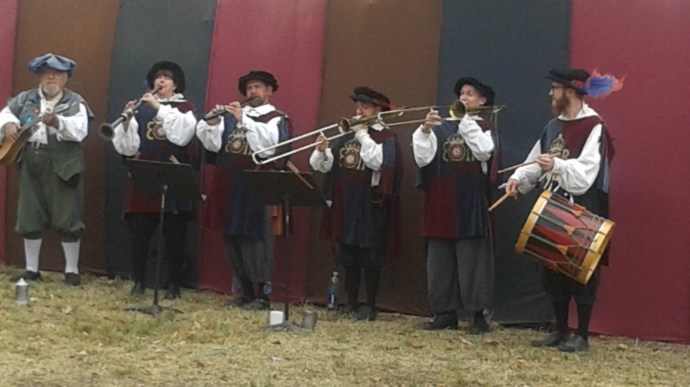
musician at the gate

Musicians at the gate, welcoming visitors. 


Huzzah! It’s time again for the annual trek to the Renaissance Pleasure Faire in Irwindale, California. A whirlwind trip back in time to ye goode olde days of Elizabethan England.

Yes, it is called a Renaissance Faire but to be honest, it’s in reality, an Elizabethan Faire. Three points bring me to this conclusion. First, the Anglicans are clearly in power, speak to any of the Guild members and the will tell you of the persecution of the Catholics. Second, much of the entertainment is Elizabethan, from the music to the Shakespeare parodies. And third and most importantly – the queen in charge is Queen Elizabeth, in all her glory.

I go to people watch. There is a myriad of humanity on display at Ren Fair. I find there are three groups who attend: Historical Reenactors, Cos-Play Fanatics, and Modern Dress attendees.

The Historical Reenactors work hard to “get it right.” Many are members of the guilds that specialize craft or lifestyle. For example, the Guild of St. Cuthbert. They are a group of reenactors that portray the peasant (lower) and middle classes of Elizabethan and Victorian England. Other groups specialize in weaving, glassblowing, military units, and the nobility; to name a few. I have to give them respect. They know their history. But they “English” they speak is not truly Elizabethan/Shakespearean English. Due the Great Vowel Shift, which between 1400 and 1800 (dates vary with the source, but all agree this was the movement from Middle English to Modern English). The sounds of the long vowels shifted dramatically during this period, so how it was pronounced then and now are different. If they truly spoke Elizabethan, we’d not understand half of what they were saying. When you go, make sure you spend some time with them. Their knowledge of the period is encyclopedic.

Cos-Play Fanatics are, let’s just face it, just love to dress up. Any excuse will do. You will see everything from very simple to ridiculously complex costumes. Many will be attempts at Renaissance/Elizabethan dress. Some of the maids take to extremes, squeezing and pushing up “the ladies” high enough to walk with a flagon of ale perched there, without assistance, as they walk through the fair. There will also be witches, wizards, knights and fairy folk. Some are out of period, but on the weekend, I was there it was “Steampunk” so they were there in high numbers. And it if you paid attention, the Doctor and many of his companions were in attendance also. Then there are the “what were they thinking” group – the World War I Doughboy, Klingons, and Stormtroopers.

The last group, the Modern Dress, are just there to have a good time, watch the people in costume, shop and eat.

I started my day out in Modern Dress – with a flower wreath in my hair, but by lunch, I was in a blouse, long skirt, and tight corset. The corset was surprisingly comfortable until I tried to drive home with it on.

It is often for the shopping that I go. The some of the sparkling jewelry there is found in no venue but fairs like Ren Fair. This year after buying the Steampunk costume, I was broke, so my shopping spree was over.


captain jack

Me with Captain Jack Harkness (Doctor Who companion)


There is also the entertainment. Demonstrations of period crafts around every turn and musicians parading down the roads could keep me well distracted. But there are also the plays (some not so family friendly) and the jousting tournaments. If you’re lucky, you may even get to speak to the queen herself, as she parades several times a day and this year she walked through the food court greeting children.


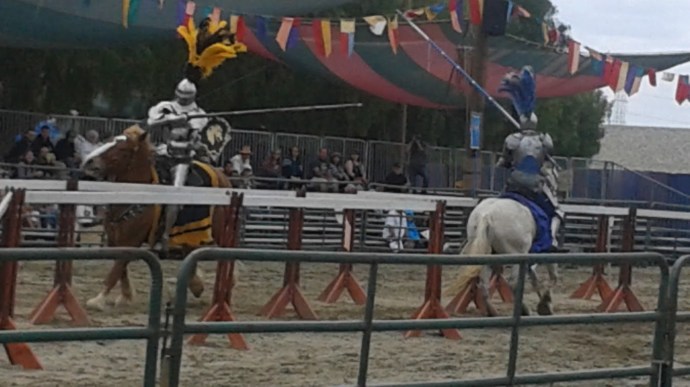
joust

Knights joust to win the lady’s heart. 


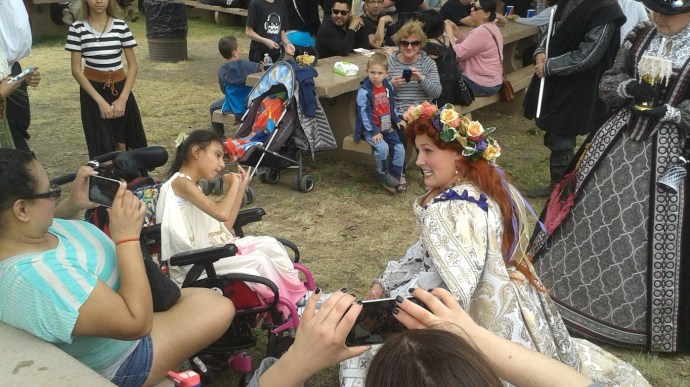
good Queen Bess

Good Queen Bess chats with a child in a wheelchair (used with mother’s permission). 


And what is Ren Fair without the food? There are turkey legs, Scotch eggs, spanakopita, sausages, Italian ice, and mead. If you wanted it, you could probably find it. This year the new menu item was sweet potato fries.

I’ll admit it – I’m a geek. Especially with it come to the Renaissance, the Victorian, or the Wild West periods. Maybe next year, I’ll see you there too.

Wishing you well and remember – the door is always open, and the kettle is always on.

Next time – Cello and the LA Philharmonic.

Categories: Uncategorized | Tags: , , , | Leave a comment

Journey to Boston: Part Three

Part III: Trollies, Trails, and Seafood

The concierge said, “Boston is a walking town.” Beantown is relatively flat and compact, so in many ways that is true. Over the three days, I walked a total of 35 miles. But you don’t have to walk everywhere, there are several tour services that will take you around.

I chose the Old Town Trolley. Their bright orange trolley-buses were a familiar sight for me growing up in San Diego, so I knew I’d get my money’s worth from them. One of the advantages of this company is the “on-off” feature. They make stops throughout the city and you can disembark visit a location and then hop back on the next one. They run about every fifteen minutes so the wait is never long.

My driver and guide was Little Dave. A native of Boston, who took great pride in his city but wasn’t shy about sharing a joke that would make your eyes roll. He was happy to share his knowledge and recommend places to visit. It was from him that I learned about the Gibson House Museum. He also recommended that I follow the Freedom Trail, a walking tour through the oldest parts of Boston.


IMGP2184

Little Dave, Driver and Tour Guide for Old Town Trolley Boston


Early Sunday morning I set out on the Freedom Trail, with my map in one hand and my smartphone set Freedom Trail website.  The walk begins in the Boston Commons, now a beautiful park but once a shared cow pasture. It wound its way passed some of the oldest structures in North America.

Here are some of the highlights:

The State House – It stands out with its 23-carat gold leaf dome. The original dome was made of copper by Paul Revere. The change was made in 1874 for the Unite States centennial celebration. During World War II, it was painted black to camouflage it.


IMGP2262

The State House, Boston


The Granary Burying Ground – Here are buried many notable Bostonians, including Paul Revere, Samuel Adams, Benjamin Franklin’s parents, and the eight victims of the Boston Massacre. The rows of tilled, moss-covered, and worn tombstones are hauntingly beautiful in the early morning sun.


IMGP2270

The Granary Burying Ground, Boston


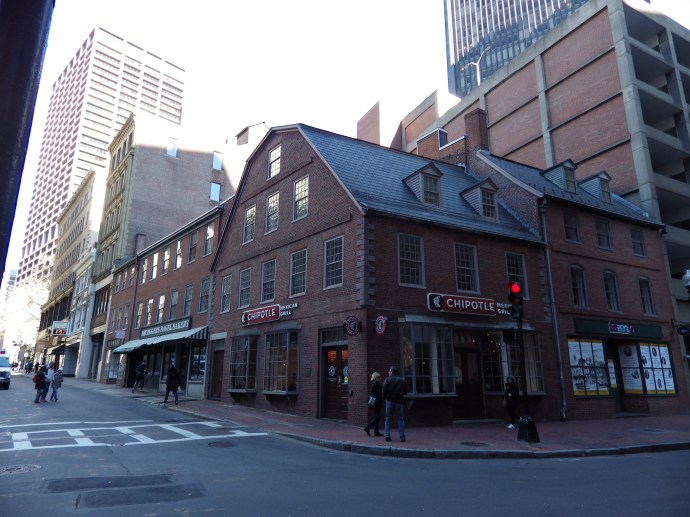
The Old Corner Bookstore – Originally built in 1636, as the home for William Hutchinson and his family the building has seen many incarnations. Destroyed by fire in 1711, it was rebuilt and used as an apothecary. In 1719, it became the home of the Boston Gazette, which is still in publication today. Since then a series of publishers and booksellers use the building. It was here that Hawthorne’s novel, A Scarlet Letter, was published, as well as many abolitionist pamphlets. Today, it is home to a Chipotle Restaurant.


IMGP2291

The Old Corner Bookstore, Boston


The Old State House – This is Boston’s oldest public building. It was here the royal governor met with patriots about the taxes and housing of British soldiers. And at its doorstep, the Boston Massacre took place. The multimedia presentation offered here is well worth the time. You are given a character, I was given Sara Revere (the first Mrs. Revere) and asked to take her perspective as I viewed the exhibits.

The Paul Revere House – This 1681 house, squeezed between modern buildings, is very small for the number of family members. The first floor was the kitchen and entry way. The second from with two bedrooms and where one had to double as a sitting room to entertain guests. An attic room provided more sleeping space. Here Revere ran his silversmith shop and raised sixteen children by his two wives. It was from here, he and William Dawes, planned their “midnight ride.” Beautifully preserved, with many objects passed down through the Revere family.

The Old North Church – Officially Christ Church, this is where the lanterns were hung that sent Revere and Dawes riding toward Concord and Lexington. The church is still an active parish and as I approached the bells were ringing calling the parishioners into worship. In need of some rest, I entered the sanctuary where an usher welcomed me warmly and then led me to a box pew near the front. It was moving to be worshiping where once the Revere family and other patriots once worshiped.

On my last day in Boston, I took a leisurely walk through the Boston Public Gardens. As I wondered I saw a statue commemorating the first use of ether by a doctor at Boston General Hospital. Just past this I meet some old friends, Jack, Kack, Lack, Mack, Nack, Ouack, Pack, and Quack. They were following their mother, Mrs. Mallard, to the duck pond in the park. You remember them, don’t you? The statues of the ducks are to honor author Robert McCloskey and his Caldecott Award winning book Make Way for Ducklings. I then wandered over to the duck pond where I saw Mr. and Mrs. Mallard, but no ducklings.

Of course, you can’t go to Boston and not have some seafood! My guide on the Old Town Trolley recommended I try Legal Sea Foods. A short walk from the Boston Public Park I one of their establishments. They are called “Legal” because they were an off-shoot of a Legal Grocery (a store that gave Legal Stamps, a precursor to S&H Green Stamps). I had a lovely meal that started with Lobster bisque. The best I’ve ever tasted. For my entrée, I chose their seafood casserole with scallops, shrimp, and white fish all covered with a white cheese sauce. It was accompanied by draft Samuel Adams Beer (that was a treat because in California we only get the bottles.) It was a bit on the expensive side, but I did not go away hungry or disappointed. If you’re in the Boston area, make a stop at Legal Sea Foods.

That wraps up my trip to Boston. I had a wonderful time. Thanks for letting me share it with you.

Categories: Uncategorized | Tags: , , , | Leave a comment

Journey to Boston: Part Two

Part II: Sailors, Brownstones, and Pasta.

charlestown-91431_1280

U.S.S. Constitution, Charlestown, Massachusetts

Boston as a long history with ships and the sea. It is currently the home to the oldest commissioned Naval vessel in the world still afloat, the U.S.S. Constitution. Yes, the H.M.S. Victory is older, but she is cemented in permanent dry-dock in Portsmouth, England and unable to sail. The Constitution, on the other hand, can be sailed out of Boston harbor should the Navy desire to do so.

Of course, this Navy veteran couldn’t pass up the chance to pay her a visit.

Built in 1797 to defend United States merchant ships from the Barbary Pirates, she was America’s first line of defense during the War of 1812. During a battle with the H.M.S. Guerriere, on the afternoon of August 19, 1812. When cannon fire from the Guerriere bounced off of her sides, a crew member declared, “I swear she’s made of iron!” Giving her the nickname “Old Ironsides.” She would fight thirty-one battles and win all of them.

Today, she is looking a little tired and undergoing a $1.5 million restoration. It’s a long process but she is still welcoming visitors.

The day I was there, my group was guided by Airman Garcia. The Constitution is still a commissioned ship of the U.S. Navy, and her crew is naval personnel. Airman Garcia was an able interpreter of the ship’s history, keeping both adult and children engaged.


IMGP2225

Airman Garcia of the U.S.S. Constitution at the end of the tour. 


After the tour, I was, with the assistance of another crew member, able to fly a U.S. flag on the ship’s mainmast. The flag was then folded and given to me. I am looking forward to placing it in a shadowbox and displaying it in my home office.


IMGP2229

U.S.S. Constitution crew members folding the American Flag 


After the visiting the Constitution, I headed across town to the Back Bay area. Here stately brownstone mansions line the streets. Once a shallow bay, the area was filled in and homes built on the “new land.” Tucked in between the old brownstones converted into apartments one remains very much as it was when it was built in 1860.


IMGP2340

Beacon Street, Boston


The Gibson House Museum was built by Catherine Hammond Gibson (1804 – 1888). It was unusual for a woman to purchase a house in their own name, but build it she did. She was the widow of John Garner Gibson (1799 – 1838), a man who had made his fortune in the shipping business. It is thought she built the house in order to attract a suitable bride for their son, John Hammond Gibson, Sr. (1836 – 1916).

Her grandson, John Hammond Gibson, Jr. (1846 – 1954) never married and lived in the house until his death. An author, poet and prolific letter writer, John Jr. want to preserve Victorian architecture and style. He began preserving the house and its contents to be open as a museum in honor of his grandmother many years before his death.

Three times a day, visitors are led on an hour long tour of the house. It eye-opening to see lavish decorations filling the narrow house. The grand staircase just inside the door led to time capsule into how the elite of Boston showed their wealth and power. Downstairs in the kitchen and laundry room, the simple space of the servant’s domain. If you are a fan of Downton Abby or Upstairs Downstairs, this museum is a must-see when you are in Boston.

One evening my husband I went to Boston’s Maggiano’s Little Italy. Just a short walk from the Boston Park Plaza, where we were staying, even at nine-thirty it was still alive with patrons. We were sat in a little booth with a view of the main room. Large tables filled with food, served family style, surrounded us. Bread and herbed olive oil were brought to the table with the menus. We kept our choices simple. He ordered “Mom’s lasagna” and I the eggplant parmesan.  The servings were generous and there was not room for dessert.


eggplant

Maggiano’s Little Italy, eggplant parmesan 


Walking the city and full of good food, it was time to say goodnight.


Coming Soon –  Part III: Trollies, Trails, and Seafood

Categories: Uncategorized | Tags: , , , , | Leave a comment

Journey to Boston: Part One

Journey to Boston: Where America Begins

This past week I was blessed with a visit to Boston, Massachusetts. It is a great city with three hundred and eighty-six years of history, making it one of the oldest cities in the United States. In this three-part series, I will share some to the highlights of my three days wandering the streets of Boston. Each will feature a place or two that I visited and one meal. Come join me on the journey.

Part One: Ships and Tea Parties

Boston is really where the story of the United States begins. It was the home of John Hancock, Samuel Adams, John Adams and Paul Revere. Benjamin Franklin was born in Boston, though he later made his home in Philadelphia. The first shots of the American Revolution could be heard in Boston, but I’m getting ahead of myself.  In the 1870’s a series of events would change a group of British colonies into a united independent nation. One of these events would become known as the Boston Tea Party. On December 16, 1773, ships, taxes, and tea collide. That night a group of young men, calling themselves the Sons of Liberty and disguise loosely as Mohawk Indians, snuck aboard three ships and dumped their cargo of East Indian Tea into the harbor. The act lead to the blockade of Boston harbor nearly starving the residence of the city. Other colonies united in support of Boston leading the way toward them working together for independence.

Due to dredging, which has enlarged the city significantly, the original location of the wharf is high and dry. Today you can visit a new pier within a few yards of the original Griffin’s Wharf, home of the Boston Tea Party Ships & Museum.

Upon entering the “Old South Meeting Hall,” I was greeted by Benjamin Burton (played by Armando). He gave me an identity of one of the Sons of Liberty – a role I would play during the interactive program.  From there, in our Mohawk disguises, we went aboard the Beaver and destroyed the tea. This was followed by a multimedia presentation about the aftermath of these events and how they produced the foundation for the unity of the colonies.


IMGP2189

Benjamin Burton calling the meeting at the Old South Meeting Hall, Dec 16, 1773.


One of the highlights for me was seeing one of the two known remaining tea boxes from that night. This simple wooden cube had been saved and passed down the generation of one family. When I saw it I thought it was very much like the one I had seen at the National Portrait Gallery Washington D.C. in 1975. It actually was the same box! The Robinson Half Chest (as it is called) had been on display there before being moved to the Tea Party Ships & Museum as part of their permanent collection.


IMGP2191

A replica of the Beaver, one of the three ships carrying tea. 


The visit didn’t end there. After the tour, Mr. Burton led the group to Abigail’s Tea Room. He introduced us to Mercy Scollay (played by Diana). In the tea room were lunch items, sweets, and tea for purchase. The tea room highlighted samples of the five teas that would have been on board the three ships that night.

With my tea cup in hand, I sampled the teas.

First up was Souchoung. Made from the older larger leaves of Camellia sinensis, they are smoked of over pinewood fire before they are fermented to make a strong black tea. It was one of the more popular teas during the colonial period. Miss Scollay warned me this was a tea that “you’ll either love or you’ll hate.” It was not like anything I had tasted before. This tea was very strong and had a smoky taste. It was like drinking barbecue.

The second was another black tea, Congou. This tea was one of the more expensive teas and was served in the more elite homes. It was full-bodied and well-balanced tea, reminding me of a very good English Breakfast.

The third was the last of the black teas, Bohur Blu. This was the least expensive of the black teas and would have been found in most homes before the passing of the 1773 Tea Tax. The taste on the bitter side and reminded me of your basic tea bag from the grocery store.

The last two teas were green teas. This surprised me. I asked Miss Scollay about this, thinking it rare for green tea to be found outside of Asia at this time. She said that the shipment on the ships destroyed during the Boston Tea Party would have been the first shipment to colonies.

The first of these green teas was Young Hyson. This tea was said to be Thomas Jefferson’s favorite and that he served it at the White House during his presidency. It was a light flowery tea that reminded me of jasmine green tea.

The final tea was Singlo. Picked later in the season, when the leaves are larger, this green tea was a very strong. It reminded me the tea served in Japanese restaurants today.

After sampling the teas, I poured myself a full cup of the Congon to drink with my cranberry-orange scone. As I enjoyed my refreshments, I continued to chat with my new friends. Diana and Armando broke character to tell me about their work. They told me most of the cast were either professional actors or historians. They truly enjoyed working at the Boston Tea Party Ships and Museum, especially with school groups come to visit. The interactive-multimedia presentation “brings the story to life, makes it real for them,” explained Armando.


IMGP2201

Benjamin Burton and Mercy Scollay, Abigail’s Tea Room


I enjoyed my visit to Griffin’s Wharf. A special thank you to Diana and Armando for sharing their time and knowledge with me.

Coming soon:

Part II: Sailors, Brownstones, and Pasta.

Part III: Trollies, Trails, and Seafood

Categories: Uncategorized | Tags: , , , | 2 Comments

Oh Look! A Pelican!

Oh look, a pelican!

If you’ve known me any length of time you will know that I am easily distracted by dogs, horses, and birds. If one of these creatures comes into my visual field, you will lose me briefly. One bird, in particular, will capture my attention – the brown pelican.

The brown pelican is a miraculous bird. When I was growing up, they were a rare sight on beaches of Southern California, as their numbers dwindled due to the use of the pesticide DDT. But since the toxin has been banned in the United States the population has rebounded. Just a few years ago I saw a large gathering on the rocks and islets off of coast of Mendocino. Hundreds of them had gathered in preparation for migration. The sight held me mesmerized. I almost forgot to breathe.

When I began writing my novella, Leap of Faith, I wanted to name some of the native animals found on the beautiful islands of the Bahamas. I discovered the brown pelican could be found soaring over the cays of this Caribbean country. So I put one in my story.

pelican-378709_1280

Leap of Faith tells the story of Grace, an administrative assistant, working for a Chicago candy manufacturer. Her life takes an unexpected turn one frosty morning when she is knocked off her feet, literally, by a stranger. Not content to remain a stranger, Philippe Santiago offers her a job on his sugar plantation in the Bahamas.

Here is Grace meeting George, the pelican, for the first time as she arrived on Orchid Cay. An excerpt from Leap of Faith:

As they stood on the dock, their luggage was carried down the gangway and loaded into a lime-green golf cart by the lanky, dark crew members.

A light breeze caressed Grace’s cheek. She took in a deep breath and sighed.

“Are you all right?”

“Yes.” She smiled up at him. “I’m just amazed. The air even smells like vanilla.”

“That would be the wild vanilla orchids that give the island its name.” He put his hand on the small of her back and turned her inland. “It is just a short walk to the house.”

A brown pelican waddled over to her and opened its greedy mouth. Grace didn’t know whether to laugh or cry at the sight of the poor, ungainly bird and its crooked wings.

“That would be George. He was blown onto the cay during a hurricane last year. Xandra nursed him back to life, but he is too badly injured to care for himself now. He follows her around like a puppy. I’m certain she’s still fishing, so he waits and hopes someone, anyone, will give him a fish.”

“Hey, boss,” called a dark, lanky man unloading their luggage, giving them a bright smile. “I got some fresh bait cut in dat bucket. If you want, I can share with George. Then pretty lady be his friend.”

“That’s an excellent idea, Charlie.”

Philippe reached into the bucket, pulled out a large chunk of fish, and handed it to Grace.

She took the slippery fish between her forefinger and thumb, cringing as she held it at arm’s length. She tentatively dropped it into George’s beak pouch, which he quickly snapped shut with a loud clack.

“Oh,” she said jumping back.

“Don’t you worry, George, he not hurt pretty lady.” Charlie laughed. Grace couldn’t help but smile at the man who towered over her. “Give him another piece.”

She gave the bird second bit of fish and this time she was less timid.

“That should keep him happy until Xandra gets home later this afternoon,” Philippe said. “Now, it’s just straight up this path to the house.”

I hope to have Leap of Faith ready for you to read in its entirety very soon. In the meanwhile, sit back and have a cup of tea.

Categories: Uncategorized | Tags: , , , | Leave a comment

Remember . . . the importance of story.

Remember . . .

Stories often begin with “Remember when . . .” Events are marked by “Remember this . . .”

We are told stories from infancy some are real, some are fairytales. We are told stories by our parents, our grandparents, our siblings and our friends.

Sharing stories is nothing new. The human race has been telling stories for millennium. The first stories paintings on cave walls, the first graphic novels really, saying “Remember us.” Ancient kings and scribes left records of great deeds and powerful events, saying “Remember us.” Biblical prophets said, “Remember.” Jesus said, “Remember.” Paul said, “Remember.”

Why is it important that we remember and continue to retell the stories?

Perhaps it is what binds us together in community. The stories we share. The common history we commemorate. They define us as a people. They tell us who we are. They pass down our culture and our values to the next generation. We demonstrate who we are by the stories we choose to remember.

Remember the day President Kennedy died?

Remember when the towers fell?

Remember when the Angels won the World Series?

But sometimes it’s important to reflect on the stories that get forgotten, pushed aside or just ignored. That says something about what we valued at that time and how much things have changed.

Who remembers Garrett Augustus Morgan, Sr. (March 4, 1877 – July 27, 1963)? He was an African-American inventor. He patented the safety hood, the prototype for the respirator firefighters wear today, and the traffic light, which has prevented countless accidents.

Garrett Morgan

Who remembers Rosalind Elsie Franklin (25 July 1920 – 16 April 1958)? She was Jewish-English chemist and x-ray crystallographer. Her photo, shown to Crick and Watson, without her knowledge, was the key to unlocking the molecular structure of DNA.

Rosalind Franklin

Who remembers Margaret Heafield Hamilton (born August 17, 1936)? She was the computer scientist who wrote, by hand, the code used by NASA to land a man on the moon.

Margaret Hamilton

Within our families, we do the same story telling. It gives us our history as an individual; it binds us into a family.

Remember your great-grandfather crossed the prairie in a covered wagon.

Remember when we went to the Grand Canyon?

Remember when your little brother was born?

But even families have stories that get swept under the rug. Things we’d rather have forgotten. Things we are ashamed of. Things that hurt too much to remember.

Who remembers the cousin that got pregnant and had to “go away” to visit a distant aunt?

Who remembers the sister, who died of a drug overdose?

Who remembers the great-great-grandfather who was hung as a horse thief? (Okay, if you’re writing a family history, this little bit of scandal might be interesting.)

And perhaps this is why I write, to tell the stories that need to be told. Even though novels are fiction, they tell the story of what people valued. Who did they think were heroic? Who did they think were villainous? Stories can change minds.

Would the Civil War have happened in 1861, if Uncle Tom’s Cabin hadn’t been written?

1853_UncleTomsCabin_Jewett

Would we have dared dream of landing on the moon, if From the Earth to the Moon hadn’t been written?

From_the_Earth_to_the_Moon_Jules_Verne

Would our food supply be safer, if The Jungle hadn’t been written?

TheJungleSinclair

Stories are also where we learn. We learn new vocabulary and facts. We learn empathy and problem-solving. We experience new things and emotions. All of this from the safety of our favorite chair.

Remember to share your stories – real or imagined. They are important. They are powerful. They are you!

Categories: Uncategorized | Tags: | Leave a comment

Sharing My World

Sharing my world with others and learning about them has always been one of my reasons for traveling. But sometimes the world comes to me. I’m still recovering from the whirlwind visit of thirty-six students from Okinawa, Japan to one of the schools I service. I was given the honor of hosting one of the three teachers, who accompanied the students, Mami Shiroma.

On a Wednesday evening, the student arrived from their long journey from a small Japanese island to a town in the high desert of California. The first think I’m sure they noticed was how dry and brown everything was, so different from their home of subtropical humidly and foliage. The streamed off the bus and into the school library where they were greeted like rock stars by the American students – screaming and signs waving.

Arrival

Stood back quietly, watching Mami and her fellow teachers get their students sorted out. Then short celebration of welcome. As we gathered the suitcases, a DJ played “Dancing Queen.” When the two teachers from Japan, Zee Hall (a school staffer) and I simultaneously made the same dance move – we were instant friends. Cultural and language barriers were trumped by a shared passion for ABBA.

Dancing Queens

On arrival at our home, Mami was warmly greeted by the furry residences of the household. This helped may her feel at home as she has a pooch at home. She saw several items that came from my time when as a Navy Lieutenant I was stationed on Okinawa. We wouldn’t get a chance to talk about my time on the island until the next day.

After a day of visiting the campus and following the students around, we finally got a chance to talk about what I remembered of the island. I learned that my favorite department store had closed, that our favorite restaurant was owned by her best friend’s family and that aquarium park where I met my first whale shark had a new name. The pineapple winery, the bingata factory and the glass factory were still going strong with both locals and tourists visiting.

And of course, there was shopping. Mami and her students were given a trip “down the hill” to one of our major shopping malls. But on Saturday, Mami and I hit the grocery stores. Yes, they are different than the ones in Japan. So we loaded up on American treats for her to take home.

Twice during her visit, Mami cooked for us. It had been nearly twenty years since I had tasted homemade curry or ramen. The scents and the flavors brought back many memories.

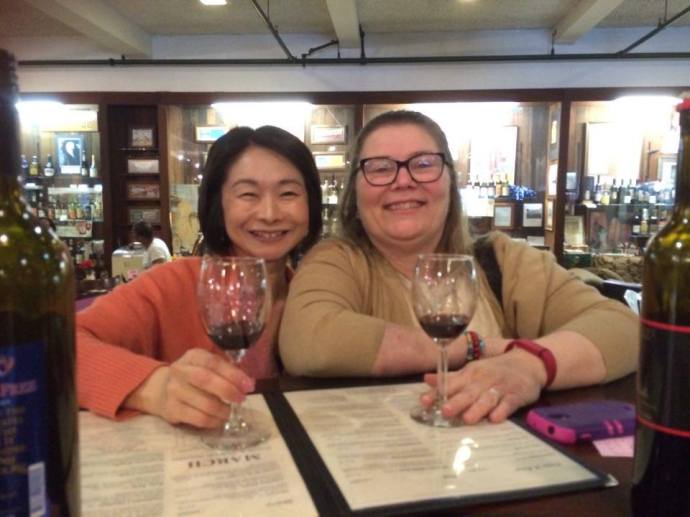
There were two things Mami said she wanted to do – visit a winery and Trader Joe’s. So on her last full day in the United States, we headed down the hill to the Joseph Felipe Winery and the closest Trader Joe’s.

The Joseph Felipe Winery & Vineyards was founded in 1922 in Rancho Cucamonga. It has survived prohibition, the depression, and hard economic times. Producing award winning wines every season.

We saddled up to the wine bar with our tickets for tasting and made our choices.

First up for me was a lovely white Moscato and for Mami a delightful Raspberry Sparkling Wine.

My next sample was a Tres Viñas, a red wine, which to be honest, I didn’t care for. For Mami, it was White Sin, a very light blush wine.

For round three, I started on the “fortified” wines and chose a nutty, sweet sherry called Angelica Elena. Mami stayed with the wines and tried a Chardonnay that wasn’t overly sweet, classic for California.

Round four I chose Alicante Bouschet, a dry port with a rich color, and Mami tried the Extra Dry Sparkling Wine, it was very good, better than Brut Champagne.

For the last round, it was Fondante Ciello, a chocolate port, for me. It was heaven in a glass. (I bought a bottle of this one.) Mami tried Ol’Glory RR Red, a blend of several grapes with a nice balance, neither too dry nor too sweet.

Mami purchased a couple of bottles to take home and then it was time for a quick snack before heading off to Trader Joe’s.

Wine tasting

We left Trader Joe’s with a basket full of goodies for her to take home.

Returning to the house, Mami packed. (I’m still not sure how she fit all of that into her suitcase.) While she busied herself with that task, I made a typical Sunday dinner – Roast Beef with potatoes and carrots.

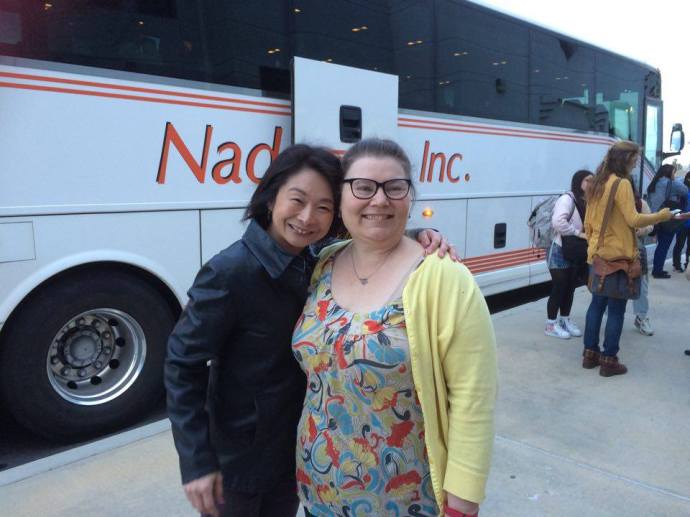
Early Monday morning, the students and teachers boarded a bus to leave our community. With a stop at Universal Studios before boarding the plane home, they appeared tired and happy. Yet, there were a few tears, it is never easy to say farewell to friends.

Sayonara Mami – we’ll see each other again soon.

sayonara

Categories: Uncategorized | Tags: , , , | 2 Comments

Blog at WordPress.com.